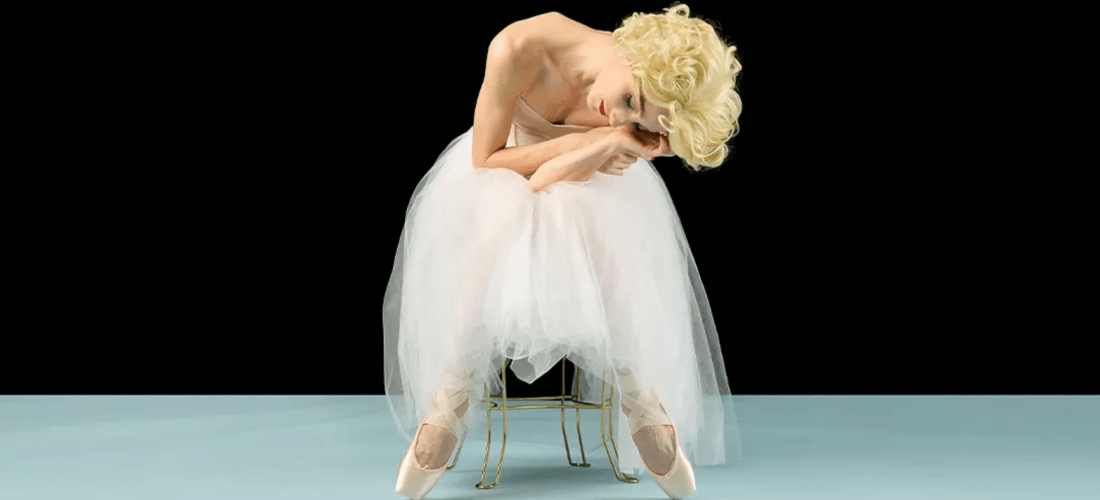
Marilyn Monroe™; Rights of Publicity and Persona Rights are used with permission of The Estate of Marilyn Monroe LLC. Carly Wheaton | Photo by Christopher Peddecord

You’ve never seen ballet like this

Reviews

Marilyn Monroe parts a sea of tuxedoed men and saunters down the stairs in a fuchsia gown, hips swaying as she twists wrists bejeweled with glittering diamonds over elbow-length gloves. She smiles at the audience, red lips bright in the spotlight. Then she steps en pointe and dances across the stage to a swelling orchestral arrangement.

Turning the story of Marilyn Monroe’s life into a full-length classical ballet is an idea that never in a million years would have crossed my mind. But luckily it crossed the minds of Oregon Ballet Theatre’s artistic director, Dani Rowe, and costume designer, Emma Kingsbury. According to the program notes, the idea sparked after they watched Kim Kardashian wear Monroe’s dress to the Met Gala and then viewed prints of Andy Warhol’s series depicting Monroe in both color and black and white, perfect and imperfect.

“This contrast spoke to the duality of her persona — the radiant star and the woman struggling with inner demons,” Rowe wrote.

Unlike OBT’s recent productions of “Giselle,” “The Nutcracker,” and “Swan Lake,” (all incredible, by the way) this show was created from scratch by Rowe and the OBT team. I saw it a week into the world premiere production – one of the last performances here in Portland before the show moves on to Oklahoma and Ohio to be performed by their local dancers.

As an original production, there are a million ways the team could have chosen to produce it, merge the story and the form, and make a statement. Many of those approaches could easily have fallen flat. Fortunately, the OBT team pulled it off, creating a brilliant amalgamation of two great things made better through the act of combining them. A chocolate-covered potato chip, if you will.

Narratively, the show tells Monroe’s story through her relationships with the people closest to her: her troubled mother, a series of foster parents, a first love, acting school classmates, second and third loves, a psychoanalyst, and a seemingly neverending stream of costars and production teams. This approach allows the audience to see Monroe not as a static image but as a growing person with as many dimensions as her signature diamonds.

Not exactly a character but a force nonetheless are the paparazzi, portrayed by a series of figures masked and wearing dark uniforms, who lift her up and carry her away and take flash photos and enable and block and comfort and frustrate her in equal measure. Their presence on the stage helps visualize what must have been running through her mind with every step, every word, every smile: people were watching her. Over the course of the show the paparazzi became more aggressive, requiring her to choose whether to fight or let them sweep her off her feet, away from those who know her as a person.

As Rowe said in the quote above, the show focuses on exploring the dichotomy of this dazzling celebrity figure and the real person underneath. On the surface it’s a rags-to-riches story, but digging deeper, we see that the forces that brought her out of poverty and into the spotlight also prevented her from living the life she wanted and connecting with the people she loved. One of the scenes that will stick with me is Marilyn swinging on a (real) rope swing, wistfully watching four women dote on their baby carriages. She wants what they have. They idolize her. Both sides yearn in a “grass is greener” complex. For my part, I sat there watching from the box seat I purchased with my own money, grateful those are no longer the only two life paths afforded to people born female.

I loved, loved, loved seeing the familiar company of OBT dancers in new costumes and environments. They traded the beige and white tunics and corsets of most classical productions for a 1940’s/1950’s wardrobe of neon A-line skirts and business suits — clothing that could make you forget you were watching a ballet until the dancers started dancing. The standout costumes were, as to be expected, Monroe’s: the aforementioned bright pink gown, the white grate-fluttering dress, the President’s Birthday skintight skin-toned number. As much as the show was about de-idolizing Monroe, it was impossible not to get a little swept up in the same allure that captured the world. On the Newmark Theatre stage, she shone.

Carly Wheaton | Photo by Christopher Peddecord, shared by Oregon Ballet Theatre

The cast in this performance was full of my favorite dancers: credit is due to Jessica Lind (Monroe), Charlotte Zogas (child Norma Jeane), Eva Burton (mother), Hannah Davis (young Norma Jeane), Benjamin Simoens (James & psychoanalyst), John-Paul Simoens (Joe & father), Brian Simcoe (Arthur), and Bailey Shaw (Kennedy), as well as the entire ensemble. As with every OBT performance, I was amazed at their technical skill and amazed at how they made me feel the full range of human emotion through wordless movement.

I’ll end with the ending: Monroe, dying a relatively un-dramatized death, a poignant flashback of her youth and dancers from each era of her life, and then giant, sheer tapestries of Warhol’s depictions fluttering down and filling the stage as real recordings of Monroe’s voice played.

After two hours of no voices — just Shannon Rugani’s captivating prerecorded score — Monroe’s voice caught me by surprise and served as a visceral reminder that this was a real life, cut short far too soon. Tears streamed down my cheeks as the curtains fell.
Twelfth Night, 21 Nights Apart

Retrospectives, Reviews

Picture it: Opening night of a Shakespeare production.

You’ve just been told you’re going on as one of the leading roles.

And you don’t know the lines.

That’s what happened at Portland Center Stage’s official opening of “Twelfth Night” on Nov. 29. Right before the curtain rose, the director came out to introduce the production and announce the role of Orsino would be played not by the PCS star performer cast in the role but by the assistant director, who’d received the assignment just a few hours beforehand. She noted he’d carry a script and some of the choreography would be altered, but otherwise the show would go on. She didn’t share the reason for the switch.

I don’t think I was the only audience member squirming in their seat with secondhand anxiety at this real-life mirroring of the classic nightmare scenario: walking onto a stage in front of a packed crowd not knowing the words. In an over-two-hour Shakespeare production, no less. And this was real life. With the central dramatic question shifting to, “Will they pull this off?“, the lights dimmed and the show began.

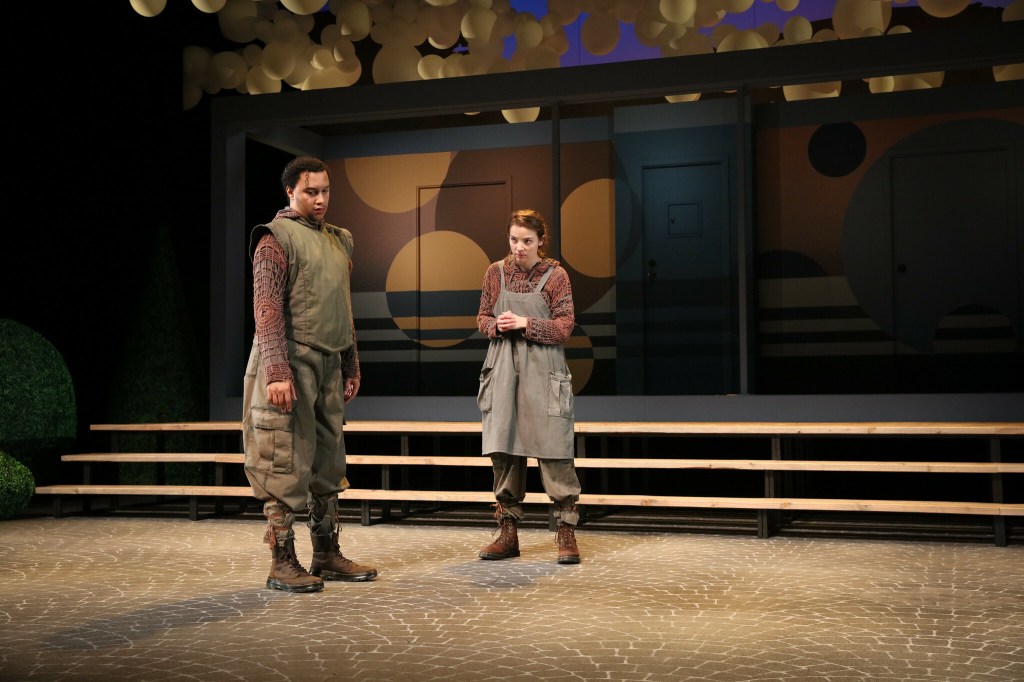
Tyler Andrew Jones as Sebastian & Lea Zawada as Viola in Twelfth Night, Or What You Will; photo by Andrés López, shared by Portland Center Stage

The impromptu-understudy, Dakotah Brown, did a stellar job. He acted through each scene with a professional grace, glancing down at the script but keeping up with his castmates as he embodied the lovesick duke who conscripts a woman-disguised-as-her-brother to woo a disinterested countess (surrounded by a no-nonsense steward and all-nonsense trio of drinking buddies also warring for her approval.)

The full cast included many familiar faces (“Midsummer Nights Dream” alumni Andrés Alcalá, Nicole Marie Green, Tyler Andrew Jones, Treasure Lunan, and Andy Perkins dazzled and delighted), a few folks new to me but not the PCS stage (Dana Green and Darius Pierce, both bringing heart and depth to their characters) and one PCS debut who slotted into the mix effortlessly and will hopefully be back for future shows (Lea Zawada, a sharp, expressive and hilarious Viola/Cesario). The Bard’s tale was in capable hands, and they deftly wove together the story of adoration, miscommunication, petty revenge and happy endings with collaborative expertise.

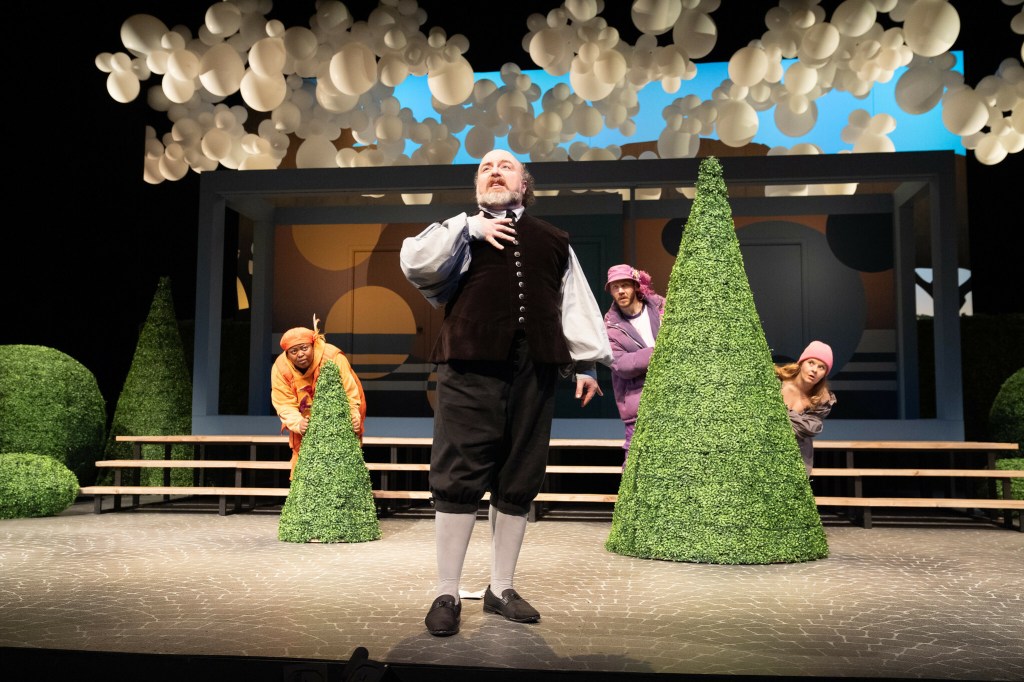
This production wasn’t exactly historical nor modern — it fell somewhere in the middle, accessible to contemporary audiences but not a full “She’s the Man” cell-phone-wielding remake. Sir Toby and Sir Andrew cracked open beers from a cooler, and in lieu of a black veil, Olivia obfuscated herself with sunglasses. The outfits were giving “Shakespeare but make it Portland,” with Viola and her twin in doc martens and Antonio sporting a mohawk. Costume designer Alison Haryer deserves a shout-out for putting the aforementioned beer-chugging sirs in matching neon tracksuits, inviting the audience to take them with all due respect (which is to say, none at all.) Peter Ksander’s sets were sleek and gorgeous, mostly free from props — minus the evergreen trees that enabled the best physical comedy bit in the show as the trio ducked and rolled around to evade detection.

Treasure Lunan as Sir Andrew Aguecheek, Darius Pierce as Malvolio, Andy Perkins as Sir Toby Belch, and Nicole Marie Green as Maria in Twelfth Night, Or What You Will; photo by Jenny Graham, shared by Portland Center Stage

I’d also be remiss not to mention one of the quietest but most impactful pieces of this production, the work of choreographer Muffie Delgado Connelly: short interludes in between scenes where Viola and Antonio, the isolated twins, mirror each other’s subconscious body language, a small wave of the hand or rub of the neck. It’s a welcome breath in between the dialogue-packed group scenes. More importantly, it connects the two storylines through their sibling bond and helps explain how no one can tell them apart.

So, to answer the question from the beginning, did they pull it off? Absolutely. I devoured it, loved it, needed to see it again. As soon as I got home from opening night, I bought another ticket. I could have booked the very last performance, a fitting bookend against the first, but the third-from-last show, the Saturday matinee, was listed as an open-captioned production. As a hard-of-hearing person who uses subtitles for literally everything, I wanted to see how it would change my experience to be able to read Shakespeare’s text in real time.

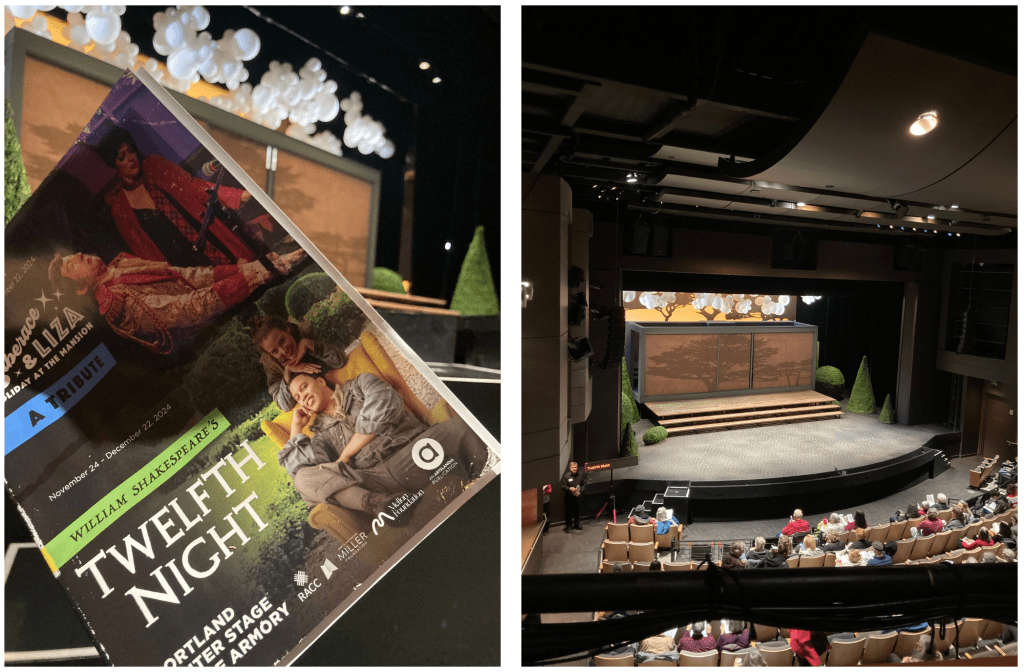
Thus, after a tumultuous three weeks of real-life drama (though no sword fights or realizations the twin I’d assumed was lost at sea had accidentally married the person I was trying to friendzone… so I guess not THAT dramatic), I returned to the theater the afternoon of Dec. 21. I sat in the balcony, which gave me a birds-eye view of the stage but was still close enough to catch all their expressions.

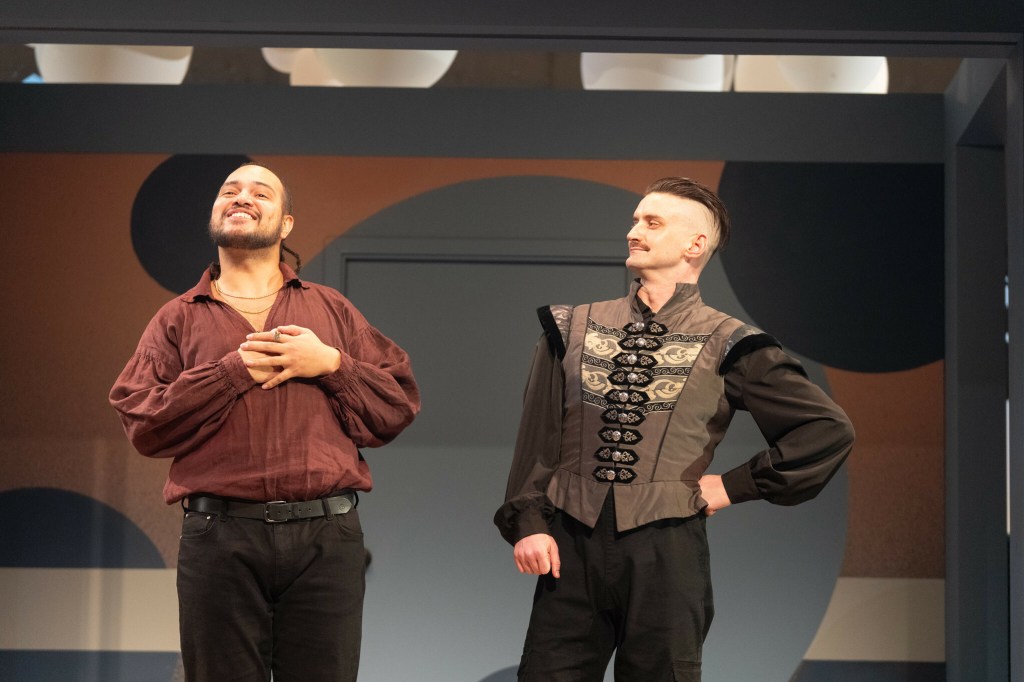
This time, Setareki Wainiqolo (who played an unforgettable PCS Dracula a year ago) stepped into Orsino’s shoes with gusto, announcing “If music be the food of loveplay on!” with such charisma the audience understood why Viola fell hard.

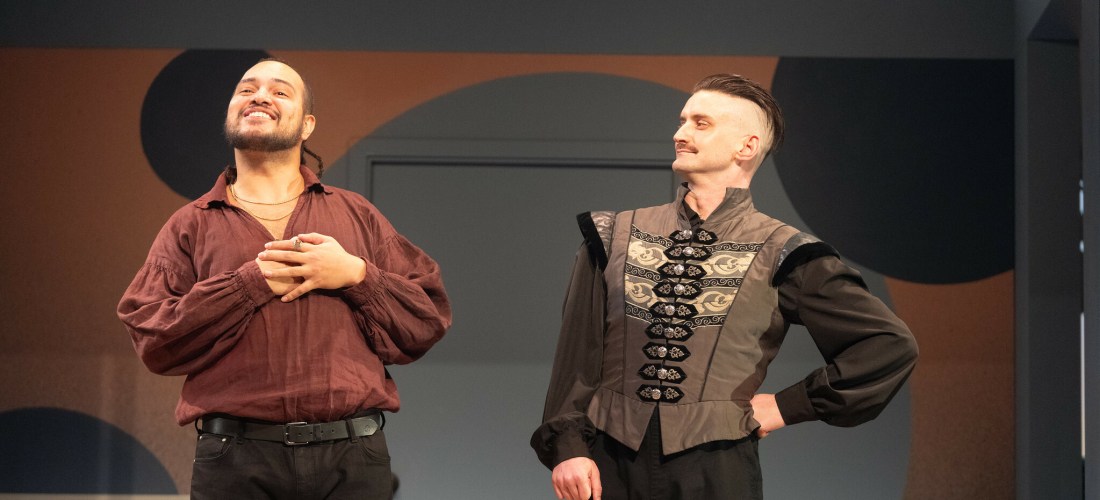
Setareki Wainiqolo as Orsino and Joshua Weinstein as Antonio in Twelfth Night, Or What You Will; photo by Jenny Graham, shared by Portland Center Stage

Without the uncertainty of a script-wielding stand-in, having seen it once before, and with the aid of a captioning display, it was easier for me to immerse myself in the story this time and just enjoy the antics. The only “new” pieces were two dance numbers that now featured Orsino — I now understood what the director, Marissa Wolf, meant when she mentioned alterations, because he’d been missing from those numbers in the first show. One of the enhanced-dances was a trio number with Orsino trying to dance with Olivia who’s trying to dance with Viola/Cesario who’s trying to dance with Orsino, all of them circling each other with barely-concealed desire, which perfectly encapsulated their whole dynamic and was just fun.

That’s what I love about PCS productions. They take nutrient-dense vegetables like Shakespeare and turn them into something you can consume, enjoy and feel satiated afterwards. Like a platter of sweet potato fries paired with a perfect aioli. (Is that a relatable simile, or am I just hungry?) As I return to the Armory time and time again to see familiar faces take the stage, I always know I’m in for a treat.

So after the holidays, I’ll be back to catch the next show at least once. (Probably twice.)

A behind-the-scenes look at Phoenix Theatre’s riveting new production of ‘Fun Home’

Writing Samples

This long-form feature was written for my Arts Journalism class. The assignment was to write a piece of 1200 words or more about an arts-related event or subject. I chose to write about a local theater production of “Fun Home.” I submitted the story on Oct. 12, 2018 and I received a grade of 100 percent.

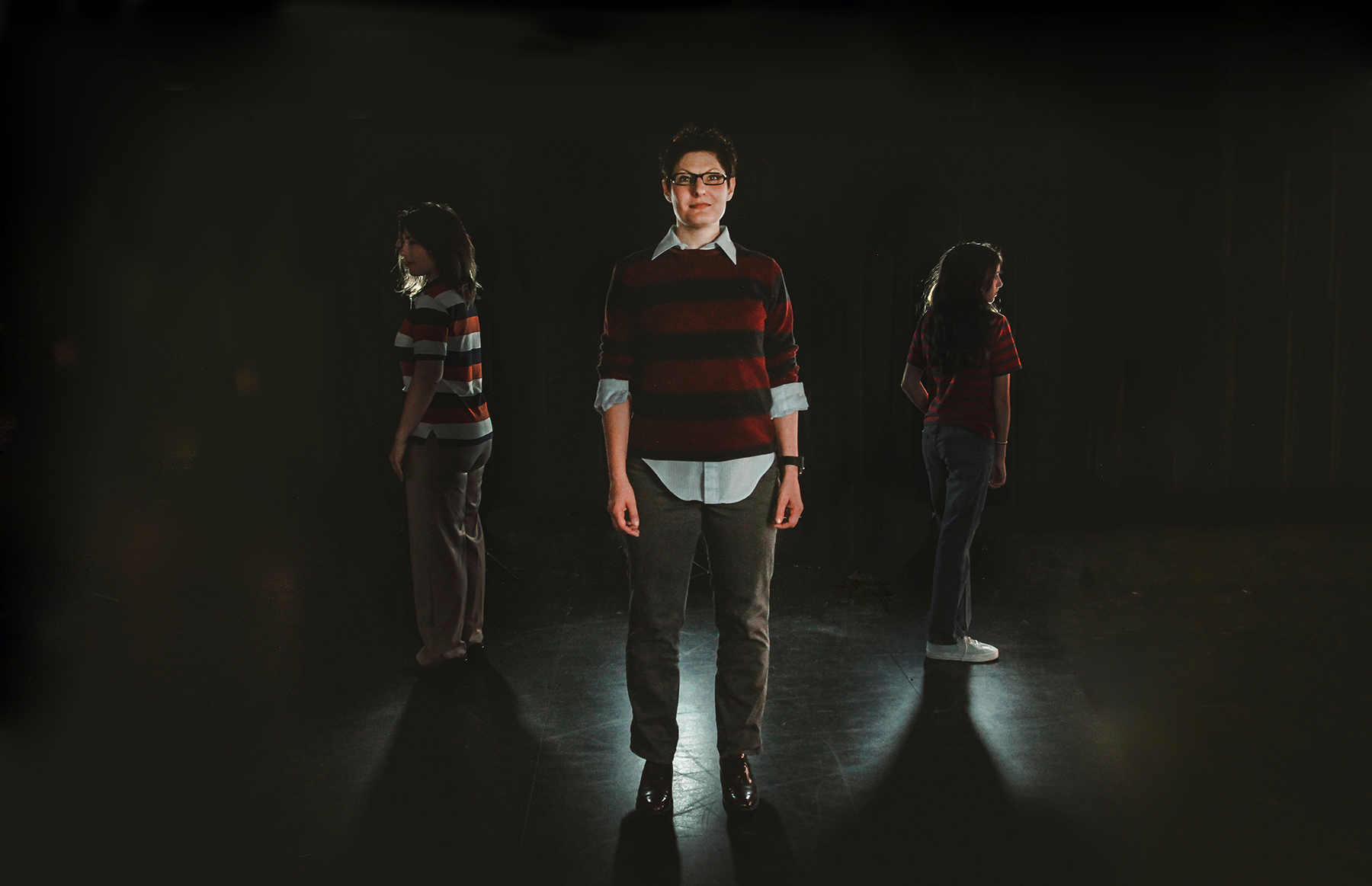
Photo courtesy of Reg Madison Photography

The title “Fun Home” conveys a sense of lighthearted wholesomeness. An ode to the 60’s or 70’s when families would gather around the dinner table for a chicken roast before congregating in front of a small TV to watch “Happy Days.”

When it’s revealed that “Fun Home” is short for “Funeral Home,” however, it takes on a grave new meaning.

That shift is at the heart of “Fun Home,” a musical that bounces between light and dark themes to explore the life of one woman through three time periods. The show opens at Phoenix Theatre this week.

Phoenix Theatre Associate Artistic Director Robert Kolby Harper is directing the production. He said the show is “a redefinition of what musical theater can be.”

“Many musicals don’t deal with universal themes,” he said. “They’re thought of as pure entertainment: ‘Take me away, make me feel happy.’ This does the same thing, but it’s satisfying.”


“She views her character, even though she happens to be a lesbian, as a human being first. If we all viewed each other like that, we’d realize our differences are way less than you imagine, less than our similarities.”


Robert Kolby Harper,
Associate Artistic Director at Phoenix Theatre