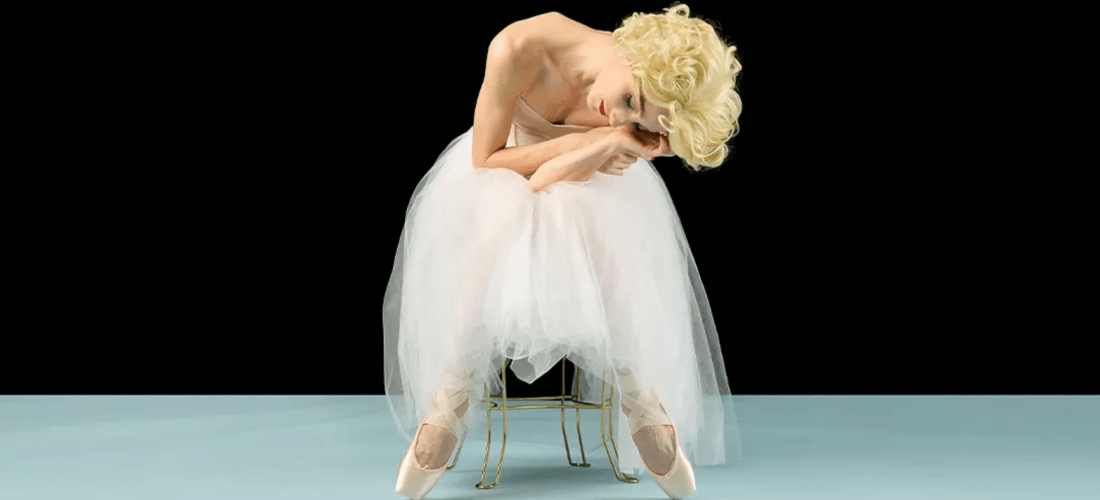
Marilyn Monroe™; Rights of Publicity and Persona Rights are used with permission of The Estate of Marilyn Monroe LLC. Carly Wheaton | Photo by Christopher Peddecord

You’ve never seen ballet like this

Reviews

Marilyn Monroe parts a sea of tuxedoed men and saunters down the stairs in a fuchsia gown, hips swaying as she twists wrists bejeweled with glittering diamonds over elbow-length gloves. She smiles at the audience, red lips bright in the spotlight. Then she steps en pointe and dances across the stage to a swelling orchestral arrangement.

Turning the story of Marilyn Monroe’s life into a full-length classical ballet is an idea that never in a million years would have crossed my mind. But luckily it crossed the minds of Oregon Ballet Theatre’s artistic director, Dani Rowe, and costume designer, Emma Kingsbury. According to the program notes, the idea sparked after they watched Kim Kardashian wear Monroe’s dress to the Met Gala and then viewed prints of Andy Warhol’s series depicting Monroe in both color and black and white, perfect and imperfect.

“This contrast spoke to the duality of her persona — the radiant star and the woman struggling with inner demons,” Rowe wrote.

Unlike OBT’s recent productions of “Giselle,” “The Nutcracker,” and “Swan Lake,” (all incredible, by the way) this show was created from scratch by Rowe and the OBT team. I saw it a week into the world premiere production – one of the last performances here in Portland before the show moves on to Oklahoma and Ohio to be performed by their local dancers.

As an original production, there are a million ways the team could have chosen to produce it, merge the story and the form, and make a statement. Many of those approaches could easily have fallen flat. Fortunately, the OBT team pulled it off, creating a brilliant amalgamation of two great things made better through the act of combining them. A chocolate-covered potato chip, if you will.

Narratively, the show tells Monroe’s story through her relationships with the people closest to her: her troubled mother, a series of foster parents, a first love, acting school classmates, second and third loves, a psychoanalyst, and a seemingly neverending stream of costars and production teams. This approach allows the audience to see Monroe not as a static image but as a growing person with as many dimensions as her signature diamonds.

Not exactly a character but a force nonetheless are the paparazzi, portrayed by a series of figures masked and wearing dark uniforms, who lift her up and carry her away and take flash photos and enable and block and comfort and frustrate her in equal measure. Their presence on the stage helps visualize what must have been running through her mind with every step, every word, every smile: people were watching her. Over the course of the show the paparazzi became more aggressive, requiring her to choose whether to fight or let them sweep her off her feet, away from those who know her as a person.

As Rowe said in the quote above, the show focuses on exploring the dichotomy of this dazzling celebrity figure and the real person underneath. On the surface it’s a rags-to-riches story, but digging deeper, we see that the forces that brought her out of poverty and into the spotlight also prevented her from living the life she wanted and connecting with the people she loved. One of the scenes that will stick with me is Marilyn swinging on a (real) rope swing, wistfully watching four women dote on their baby carriages. She wants what they have. They idolize her. Both sides yearn in a “grass is greener” complex. For my part, I sat there watching from the box seat I purchased with my own money, grateful those are no longer the only two life paths afforded to people born female.

I loved, loved, loved seeing the familiar company of OBT dancers in new costumes and environments. They traded the beige and white tunics and corsets of most classical productions for a 1940’s/1950’s wardrobe of neon A-line skirts and business suits — clothing that could make you forget you were watching a ballet until the dancers started dancing. The standout costumes were, as to be expected, Monroe’s: the aforementioned bright pink gown, the white grate-fluttering dress, the President’s Birthday skintight skin-toned number. As much as the show was about de-idolizing Monroe, it was impossible not to get a little swept up in the same allure that captured the world. On the Newmark Theatre stage, she shone.

Carly Wheaton | Photo by Christopher Peddecord, shared by Oregon Ballet Theatre

The cast in this performance was full of my favorite dancers: credit is due to Jessica Lind (Monroe), Charlotte Zogas (child Norma Jeane), Eva Burton (mother), Hannah Davis (young Norma Jeane), Benjamin Simoens (James & psychoanalyst), John-Paul Simoens (Joe & father), Brian Simcoe (Arthur), and Bailey Shaw (Kennedy), as well as the entire ensemble. As with every OBT performance, I was amazed at their technical skill and amazed at how they made me feel the full range of human emotion through wordless movement.

I’ll end with the ending: Monroe, dying a relatively un-dramatized death, a poignant flashback of her youth and dancers from each era of her life, and then giant, sheer tapestries of Warhol’s depictions fluttering down and filling the stage as real recordings of Monroe’s voice played.

After two hours of no voices — just Shannon Rugani’s captivating prerecorded score — Monroe’s voice caught me by surprise and served as a visceral reminder that this was a real life, cut short far too soon. Tears streamed down my cheeks as the curtains fell.

Thoughts from Oregon Ballet: ‘Midsummer Night’s Dream’

Reviews
Michael Linsmeier, Christopher Kaiser and Eva Burton; photo by Jingzi Zhao

/

Reflections after attending a performance of the Oregon Ballet Theater on October 8, 2022.

Walking up to Keller Auditorium on a temperate fall evening, I expected to find a line wrapped around the building that I could tag onto and perform the customary one-step-then-wait, two-step-then-wait shuffle toward the door. Instead I found the entirety of the to-be audience clustered in one big group across the street — and a fire truck with lights flashing parked outside. So the night was off to a great start.

We (the audience) never learned exactly what happened, but we could see firefighters moving around inside. I have to assume it was either A) a small fire they put out, or B) not a fire at all, maybe an alarm gone rogue; because about 20 minutes later, they cleared the venue and the hundreds of people waiting outside made the exodus across the street.

Everything seemed fine inside. Props to the Keller Auditorium staff because the show only turned out 15 or so minutes behind schedule (a veritable miracle considering the logistical challenges of scanning tickets, masking the unmasked, and getting everyone where they needed to be all at once, minutes before showtime.)

Even if it had been an hour late, I can say with certainty: the show was worth the wait. Let’s get into it.

Hush

Hush is a ballet that premiered in 2006 at the Houston Ballet, choreographed by Christopher Bruce; this was its Oregon Ballet Theater (OBT) debut. It follows a family of six circus performers in their life outside of the tent and showcases their lives individually and together. It’s set to an eclectic range of music from Bobby McFerrin and Yo Yo Ma.

The main theme I took from this piece was how a family is made up of individuals, but the family unit is an entity itself. I liked how it explored the way family members have their own personalities and stories, but when they come together they interact, play off of each other, and become something different. It showed the toll that parenting can take on a marriage and how much pressure falls on mothers to balance a hundred impossible-to-fulfill demands at once, often making them feel overwhelmed and alone. There was a father-daughter dance both playful and sweet. I enjoyed the piece and it gave me a lot to think about in terms of how these themes play out in real life.

Pas de Deux

Next was an eight-minute piece performed by two dancers, set to Tchaikovsky. The history of this piece is actually more dramatic than the dance itself: It wasn’t in the original Swan Lake, but the ballerina playing Odette in the 1877 Moscow production was so dissatisfied with the original song in that part that she requested a different composer to write a song to replace it. When Tchaikovsky found this out, he wrote his own replacement song with the same structure so they wouldn’t have to re-do the choreography. (The talent you have to have to be that petty…) However, because it wasn’t part of the original score, it was forgotten for over seventy years, until it was accidentally rediscovered in 1953 and converted into a standalone piece.

What I’m saying is that we desperately need a “The Office” style mock-umentary about this whole debacle, complete with deadpan-to-camera fourth wall breaks from Tchaikovsky.

Back to tonight’s performance: It definitely gave Swan Lake vibes (a compliment) and the OBT dancers were excellent. If they perform Swan Lake in the future, which I hope they do, it’d be cool if they could find a way to work this back in.

A Midsummer Night’s Dream

After intermission, it was time for the main event: ‘A Midsummer Night’s Dream’ choreographed by former OBT Artistic Director Christopher Stowell and set to music by Felix Mendelssohn. I watched a couple of “Explaining Shakespeare for Confused and Lazy Students” videos as a plot refresher before attending, and I’m glad I did. As a ballet instead of a play, I don’t feel like you need a line-by-line understanding of everything to enjoy the show, but it did make it more interesting to understand the motivations behind everyone’s antics.

The sets were inspired by the Pacific Northwest, which was a nice nod to the local production and gave a touch of realism against the fantastical costumes of fairies, larger-than-life bugs, and medieval lords and ladies. This was also the only of the three pieces where music was performed live by the OBT Orchestra, which was worth the price of admission just to hear.

This one also has real-life drama juicier than the plot: It includes the iconic wedding march, AND Mendelssohn wrote the whole thing when he was only 17 years old, AND after its first British performance the organist Thomas Attwood — a pupil of Mozart — left the score in a cab so Mendelssohn had to rewrite it from memory. (BUT the two later became friends and Mendelssohn wrote several songs dedicated to Attwood. So all’s well that ends well??)

Okay back to tonight’s performance: Incredible company of performers, incredible music, incredible sets, just lush and gorgeous and lighthearted and splendid all around. Special shout-out to the OBT School students who did a fantastic job and held their own on stage with the principal dancers; and to Eugene Ballet performer Nicholas Sakai, who stole the show as Puck.

Closing Thoughts

I love the ballet because it never fails to surprise me with what people are capable of. (People other than me, I mean. I have no delusions I am capable of that athleticism.)

One thing I took from all three performances, plot and production together: We are more than the sum of our parts. It’s one of the best, most surprising things about life.