What ‘All the President’s Men’ can teach us about journalism and politics in 2018

Writing Samples

This piece was written for my Arts Journalism class. The assignment was to write a 700-800 word analysis of the movie “All the President’s Men” in the context of 2018 politics. I submitted the story on Nov. 5, 2018 and received a grade of 100 percent.
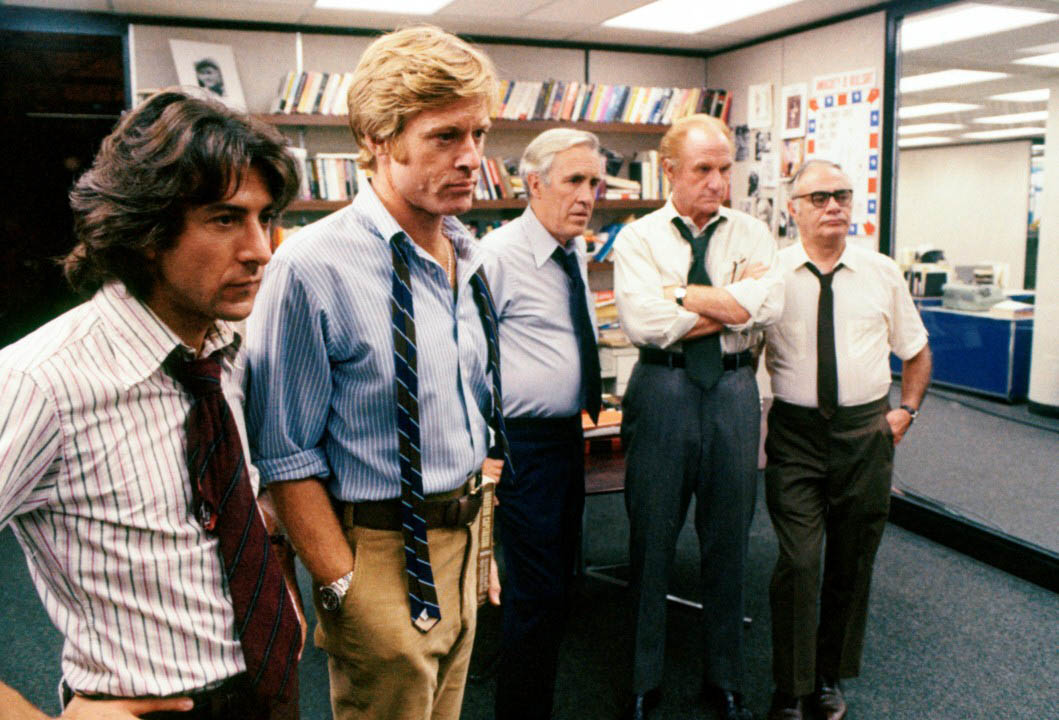
“Nothing’s riding on this except the, uh, First Amendment to the Constitution, freedom of the press and maybe the future of the country.”

Ben Bradlee (played by Jason Robards) offers this quip to reporters Carl Bernstein (Dustin Hoffman) and Bob Woodward (Robert Redford) in the 1976 film about the Watergate investigation, “All the President’s Men.”

He urges the two reporters to check and re-check their facts before publishing their story, because it will rock the government and shake the future of America. (Which it did: the scandal led to 69 indictments, 48 sentencings, and Richard Nixon’s resignation.)

Aside from the very 1970’s hairstyles and rotary phones, the story rings true today. Here are three takeaways from the movie that apply to modern journalism:

  1. Reporting is a painstaking, unglamorous process

For some reason, many people think reporters just hit speed dial, talk to the president or their insider CIA agent, and write a 12,000-word piece with the facts from one or two sources. That couldn’t be further from the truth.

“All the President’s Men” offers a glimpse of the amount of cold calls, research, problem-solving, independent verification, writing, rewriting, and editing necessary for even a 200-word story. Yet even the movie cuts corners, by necessity: it had to boil thousands of hours of work into a two-hour film.

The audience also gets to “cheat,” in a sense, because they know that something big is going to come of the investigation. The reporters at the time had no guarantees that any of their work would mean anything. Often reporters spend months tracing a lead that doesn’t even merit a story. Yet they press forward, because that’s their job.

A behind-the-scenes look at Phoenix Theatre’s riveting new production of ‘Fun Home’

Writing Samples

This long-form feature was written for my Arts Journalism class. The assignment was to write a piece of 1200 words or more about an arts-related event or subject. I chose to write about a local theater production of “Fun Home.” I submitted the story on Oct. 12, 2018 and I received a grade of 100 percent.

Photo courtesy of Reg Madison Photography

The title “Fun Home” conveys a sense of lighthearted wholesomeness. An ode to the 60’s or 70’s when families would gather around the dinner table for a chicken roast before congregating in front of a small TV to watch “Happy Days.”

When it’s revealed that “Fun Home” is short for “Funeral Home,” however, it takes on a grave new meaning.

That shift is at the heart of “Fun Home,” a musical that bounces between light and dark themes to explore the life of one woman through three time periods. The show opens at Phoenix Theatre this week.

Phoenix Theatre Associate Artistic Director Robert Kolby Harper is directing the production. He said the show is “a redefinition of what musical theater can be.”

“Many musicals don’t deal with universal themes,” he said. “They’re thought of as pure entertainment: ‘Take me away, make me feel happy.’ This does the same thing, but it’s satisfying.”


“She views her character, even though she happens to be a lesbian, as a human being first. If we all viewed each other like that, we’d realize our differences are way less than you imagine, less than our similarities.”


Robert Kolby Harper,
Associate Artistic Director at Phoenix Theatre

Estrella Jail inmates find a voice to tell their stories through Gammage’s Journey Home program

Writing Samples

Article and photos by Skylar Mason

This article was written for The State Press and published on April 5, 2016.

A young woman, probably in her late twenties or early thirties, takes a few nervous steps toward the audience. Tattoos cover her arms and neck, and “SHERIFF’S INMATE- UNSENTENCED” is printed in bold red letters across her black-and-white striped uniform. She clears her throat, glances around the room and begins to sing.

“I’m not the average girl from the video / And I ain’t tan like a supermodel / But I’ve learned to love myself unconditionally / Because I am a queen,” she sings.

Her voice starts quietly, then builds as the women around her smile in support. When she finishes the song, 12 other inmates join her in a circle and take turns reciting lines in a group poem about self-worth and community.

This isn’t a normal event at Estrella Jail, a Maricopa County facility that houses approximately 1,000 inmates, predominantly female. On Saturday afternoon, the 13 inmates gathered to present their capstone performance as a part of Journey Home, an arts residency program facilitated through ASU Gammage.

​The Acting Company to bring two touring productions to the Valley with company’s first all-black cast

Writing Samples

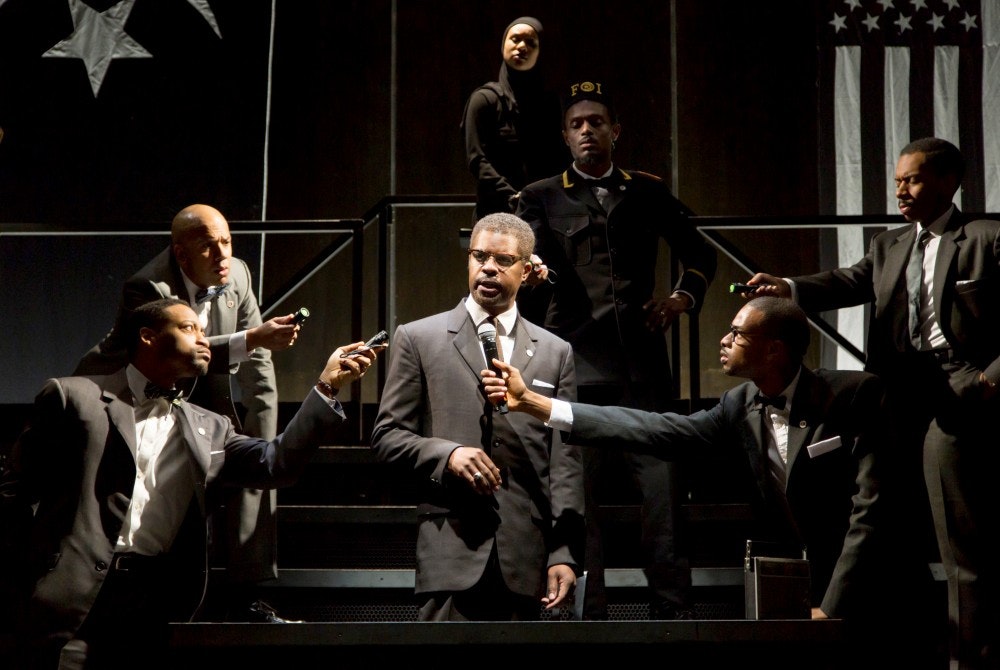
The tour includes performances of Shakespeare’s ‘Julius Caesar’ as well as a new play about the life and assassination of Malcolm X, titled ‘X’

By Skylar Mason

The cast of "X Or, Betty Shabazz v. The Nation," by Marcus Gardley, directed by Ian Belknap. Produced by The Acting Company

Photo courtesy of T Charles Erickson

This article was written for The State Press and published on Jan. 31, 2017.

In the midst of a tumultuous transition of political power, the arts have a unique ability to put today’s events into the context of history.

That is the belief of The Acting Company, a New York City-based theater company bringing its two latest productions to the Valley this week: Shakespeare’s “Julius Caesar” and Marcus Gardley’s new play about the assassination of Malcolm X, titled “X.”

Lisa Gutting, The Acting Company’s director of education and development, said at their core, the two productions—while set in completely different time periods—have similar themes.

“There are interesting connections on … why a man rising to power is being taken down in an assassination (and) the conspiracy theories that then come forth,” she said. “We hope the audience will make connections to what they’ve seen onstage and want to know more, to do their own historical digging into both Julius Caesar and Malcolm X.”

Why Louis C.K. is Wrong to Take the Stage

Writing Samples

This piece was written for my Arts Journalism class. The assignment was to analyze Louis C.K.’s controversial return to comedy in less than 500 words. I submitted the story on Sept. 5, 2018 and received a grade of 100 percent.

Photo courtesy of Kevin Mazur/Getty Images

“I have spent my long and lucky career talking and saying anything I want. I will now step back and take a long time to listen.”

That is how Louis C.K. ended a statement released last November, after he confirmed reports that he had masturbated in front of at least five women in the comedy community. While (as many critics pointed out) he never included the words, “I’m sorry,” the tone was vaguely apologetic.

Less than a year later, he is back onstage. He did a 15-minute set– unannounced– at the Comedy Cellar in New York on Aug. 26. He chose not to comment on recent events, instead focusing his act on “racism, waitresses’ tips, (and) parades,” according to the club owner.

This begs the question: how long is “a long time”? The #MeToo movement is so recent that there’s no standard for how much time perpetrators should take before stepping back into the public eye.

Sure, we could choose an arbitrary length of time. Six months, a year, five years, never…. But every #MeToo situation is different, and there’s no “one size fits all” answer.

Instead, we need to look at the perpetrator’s actions during that time. Have they actually demonstrated repentance and learned why and how their past actions were wrong? Have they used their power in the industry to support the people they have hurt? What steps are they taking to put an end to these misogynistic practices?