The Brothers Size, Part 3

Retrospectives, Theater

There was solemnity hanging in the air of the Armory as I walked down the orchestra steps.

Live theater is, by definition, ephemeral. But there’s something about seeing a production’s final performance that heightens that feeling, knowing it’s the last time these actors will speak or sing these words together, possibly the last time they’ll ever gather together in person.

For this show in particular, the sense of finality felt personal. I’ve spent the past month immersed in “The Brothers Size” and its distant-present Louisiana auto shop, as detailed in Parts 1 and 2. Today felt like a goodbye.
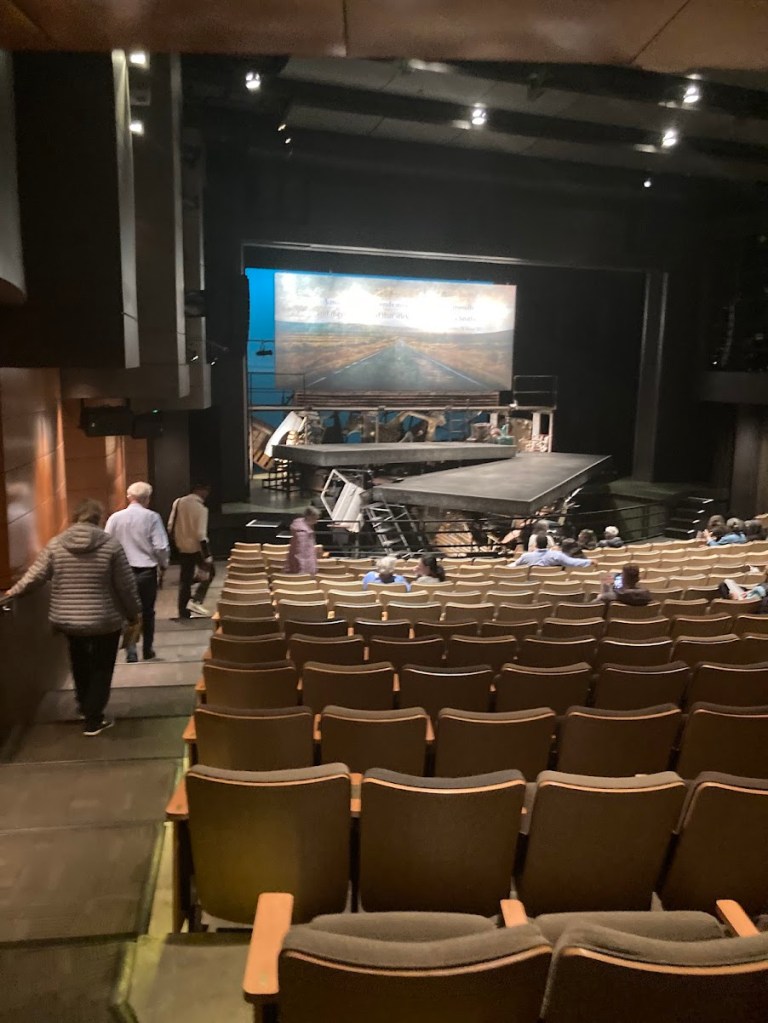
Before I get into the final show, let me fill you in on the past week. A few days ago, I had the absolute privilege to sit down and debrief with the show’s dramaturg, Kamilah Bush. It was supposed to be a class discussion, but I was the only student who came, so I basically got to gush all my thoughts and theories and favorite parts of the show and then have Kamilah explain what the production team’s intention was in designing every aspect.

It was a theater/literature nerd’s actual dream. I walked away with a deeper understanding and appreciation of every element of the show and how they fit together. (Unfortunately, this experience has also spoiled me. What do you mean, now I have to go back to seeing shows and not being able to debrief with the creative team??)

The other final gift was the script. Enrolling in the community college course granted me access to the full text of the play. In true college student fashion, I waited until the night before the closing show to read it. Between midnight and two a.m., fueled by pizza and root beer, I consumed and annotated the entire thing, peppering it with notes and observations from my previous viewings and my discussion with Kamilah. I picked up on so many things I hadn’t noticed or could connect to other elements. It was a perfect exercise to prepare for the final show.

That brings us to this afternoon, when I walked down the orchestra steps feeling a strange mix of excitement and sadness to be at the beginning of the end. I took my seat in the front row, far left, my very favorite place in the theater. (The rare instances I can’t see something onstage are frustrating, but worth it to be so close to the actors I can see every twitch of their mouth, glint in their eye, drop of sweat on their brow. The show is so much more palpable up close.)

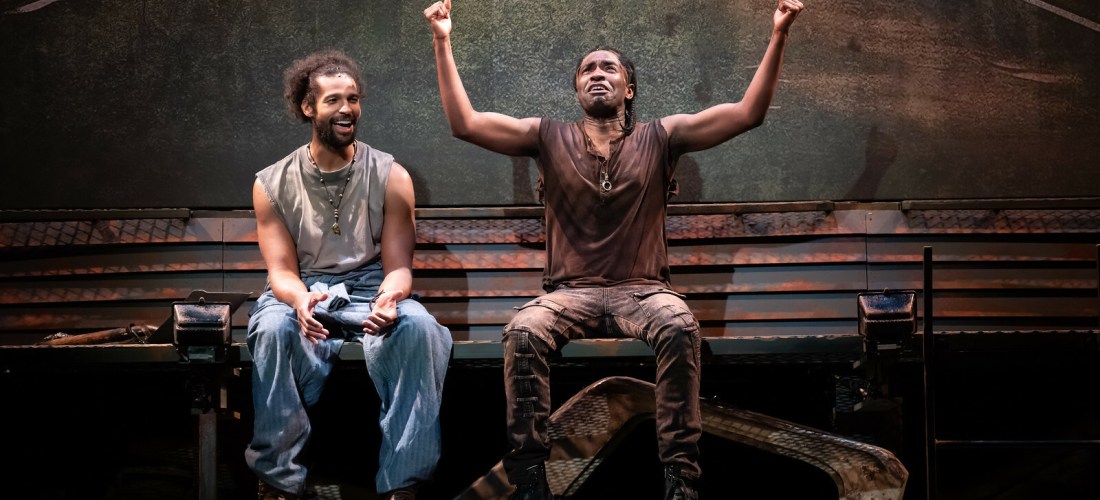
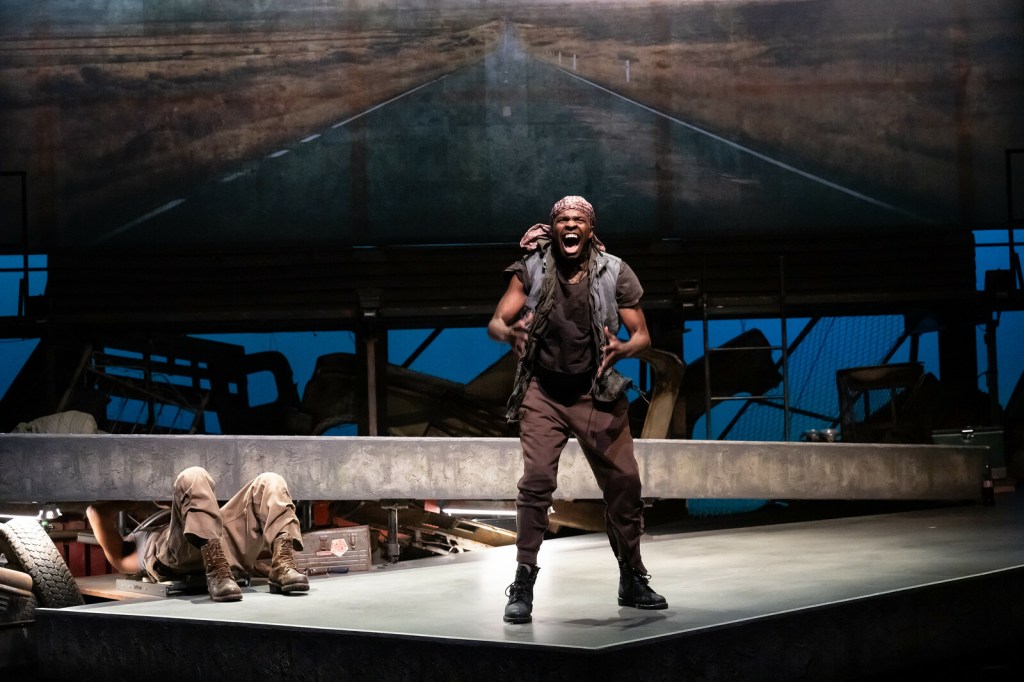
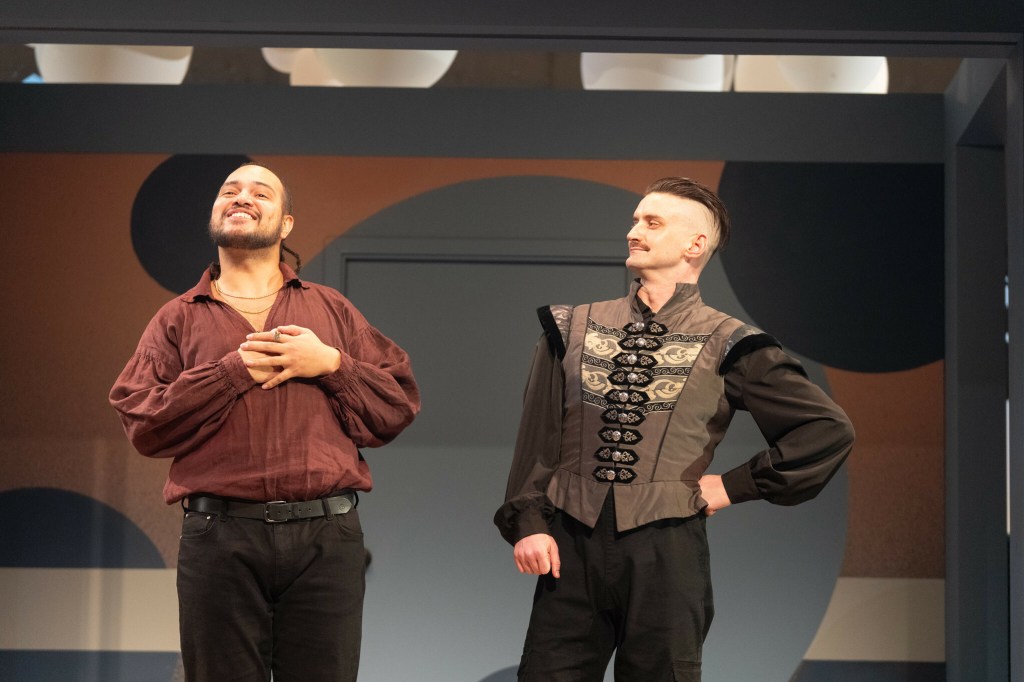
Featuring Austin Michael Young and Charles Grant. Photos by Jingzi Zhao. Courtesy of Portland Center Stage.

I reviewed the show in Part 1, so I won’t repeat all the praise I lavished on opening night, other than to say it all held true as the production came to a close. This was one of the greatest shows I’ve ever seen. (As a former theater beat reporter, I’ve seen a lot of shows.) Austin Michael Young, Charles Grant and Gerrin Delane Mitchell, with the support of the full PCS team, brought Tarell Alvin McCraney’s story to the stage with such care and skill, it was impossible NOT to be completely immersed in the world they built.

Which is why, when the lights came up and final bows were bowed, I left the theater in a haze. It was difficult to accept that it was truly over.

Well, was it? As I crossed the street and wandered aimlessly through Powell’s, found myself perched on the Guilder sitting-stairs with a tea and a scone, and then sprinted to catch the Streetcar home, my slow-and-steady realization was that the show was only over in the most literal sense.

If we think about art as not only something to be created and consumed in the moment but something to inspire deeper thinking and beget new ideas, then “The Brothers Size” — a show written in 2009!– is only beginning to work its magic. It brought me face-to-face with so many concepts that I’m going to keep reflecting on and will bring to other shows, my own art, and my sociopolitical understanding of the world.

The thinking and learning doesn’t have to end…. but this blog post does. So I’ll leave it here, very grateful for this unexpectedly three-part journey and anyone who tagged along by reading.

At the end of June I’ll step back into the Armory for the next PCS show, Kamilah’s adaption of “The Importance of Being Earnest” — after a book convention, road trip, wisdom teeth surgery, ballet, V.E. Schwab book launch, and two concerts. See you in 40 days!
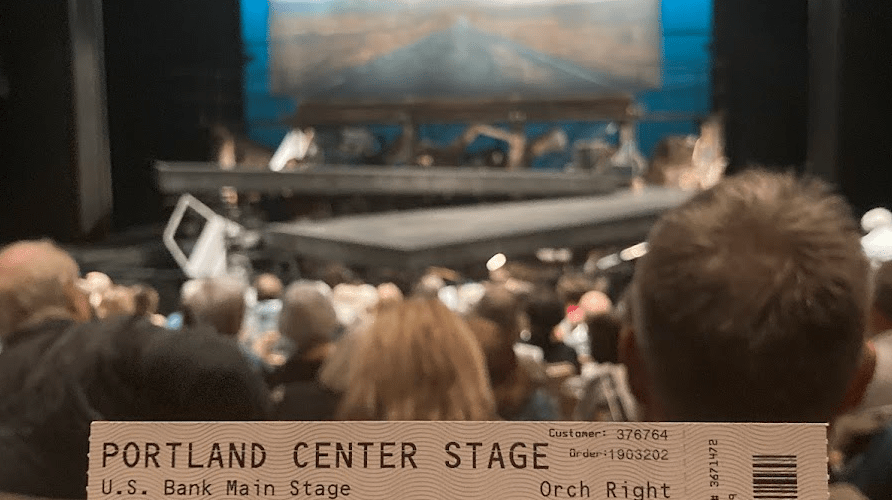
Ticket held in front of the stage for Portland Center Stage's "The Brothers Size"

The Brothers Size, Part 2

Retrospectives, Theater

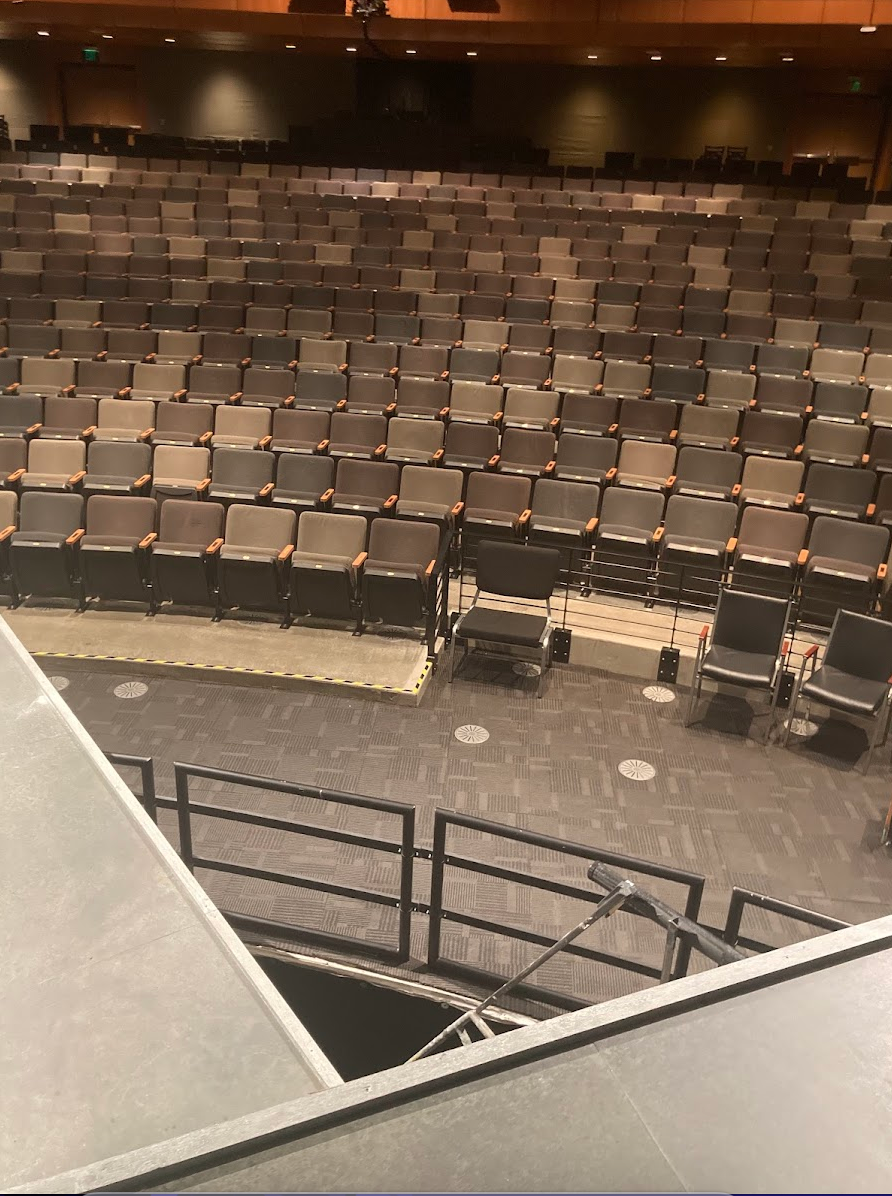
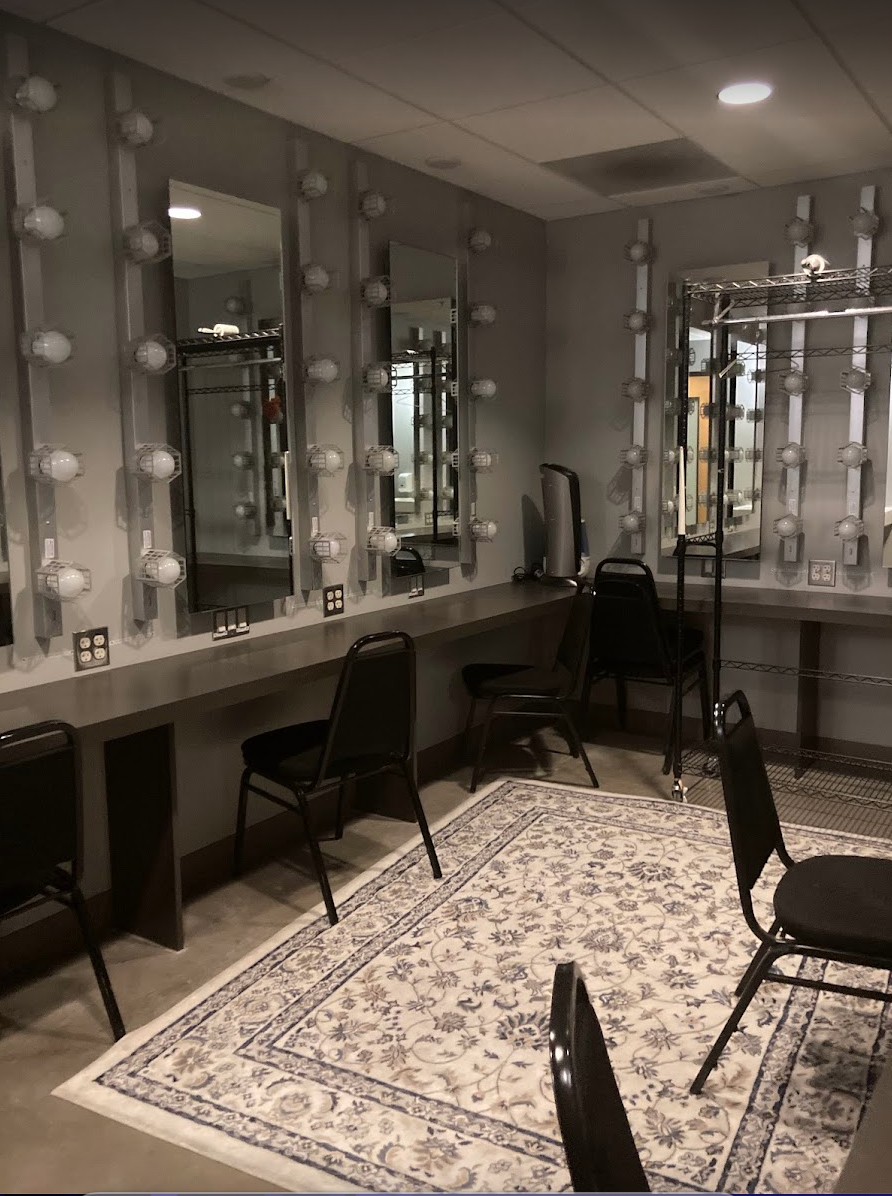
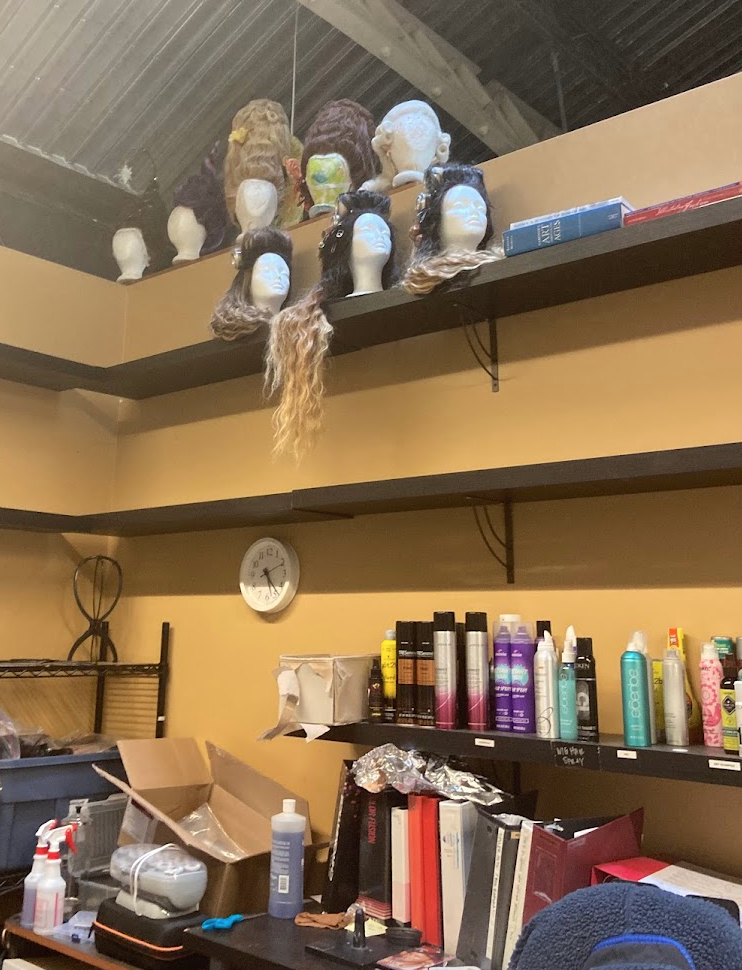
Fast forward twelve days and I’m standing onstage at The Armory looking out over 560 empty seats, riding up a backstage freight elevator with set builders, and standing in the costume shop asking designers about their process as they pin fabric to cast-measured mannequins.

[Freeze frame] Narrator: “You’re probably wondering how I got here. Well, let’s back up…”

Where we left off in Part 1, I loved opening night so much I bought another ticket for closing night and planned to write a second post.

What you don’t know is that a few days later, I saw that Portland Center Stage was also hosting a three-week “The Brothers Size” class led by PCS dramaturg Kamilah Bush. Week one, she would explain the background of the show and the process they took to create it. Week two, students would go on a backstage tour and then see the show. Week three, the class would meet again to discuss.

After a little internal back-and-forth with the reasonable side of me pointing out we were already going to see it twice and this class would be a big time commitment in an already-busy month and it was also a not-insignificant amount of money, and the other side of me being like, “but wouldn’t it be COOL?” you know which side prevailed. I signed up the night before the course started.

What I didn’t realize until I was halfway through registering was that the class was offered through Portland Community College, which meant by signing up I was literally enrolling and I’m now technically a community college student. I have a student ID number and PCC email address and everything. I have to say, it wasn’t on my 2025 bingo card, but this is what happens when you commit to the bit.

So now you’re more or less caught up: tonight was the ‘get a backstage tour and see the show’ night of class. As a longtime PCS showgoer, it was awesome to literally peek behind the curtain and figuratively see how the sausage gets made. It gave me a deeper appreciation for just how many people and how much time and thoughtfulness goes into a theater production.

Speaking of deeper appreciation, seeing the show after hearing about the history and behind-the-scenes process was also a completely different experience. Reading the script before class, I discovered there are no stage directions whatsoever — it’s up to each production to determine what the characters are doing in each moment. The set and costumes were likewise concepted completely by the PCS team. Playwright Tarell Alvin McCraney left all those decisions to the teams who would adapt his work — which Kamilah described as an ultimate form of trust. In class, I also learned how Ogun and Oshoosi are modeled after Yoruba gods of the same names — brothers, one steady and the other flighty. Elegba is a playful figure that represents crossroads with the symbol of a key. (There are echoes of all this within the play.)

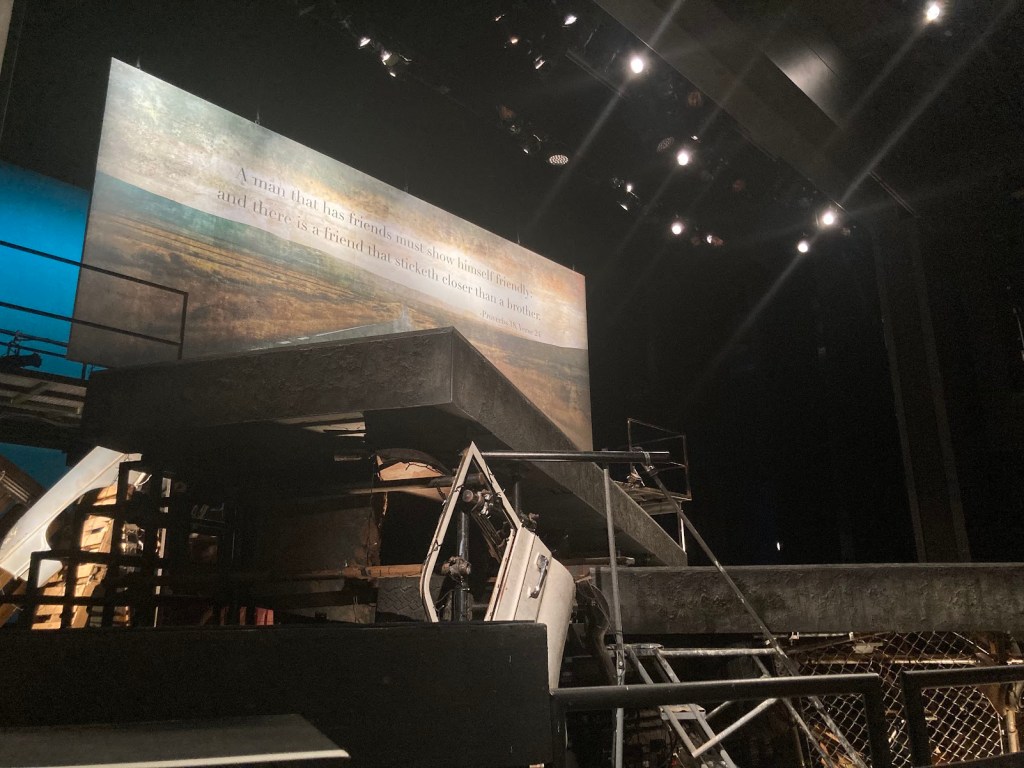
Now that I had a better sense of the plot, I could also spend more time observing the micro-dynamics: the relationships in space and word between characters, the transitions into dreams and flashbacks, the guitar-string tension driving the story forward. I also turned my attention to the backdrop, which reads:

“A man that has friends must show himself friendly: and there is a friend that sticketh closer than a brother. Proverbs 18:24”

Without totally spoiling the show (there’s still time to see it, if you’re reading this before May 18, 2025), that verse really is the heart of the play, but perhaps not in a way you’d expect. The show takes a really hard look at what it means to love someone when it’s not easy, when the way to help them is not clear. I think many people can relate to both Ogun (loving someone and wanting a different life for them) and Oshoosi (being the person feeling that pressure but unable to change your life to fit what they want.)

I’ve taken so much from this show, from this class, from really thinking deeply about the themes it offers and how they fit into my life. I’m incredibly grateful for all these opportunities to dig in. I have one more class next week, and then a front-row seat to the final show of this production.

See you in 11 days!

Two actors sit on a platform, one animated with arms in the sky.

The Brothers Size, Part 1

Retrospectives, Reviews, Theater

The best art can both 1) show you fictionalized things you’ve never seen before, and 2) make you feel like you’re watching a piece of yourself on the stage/page/screen.

Walking out of the opening night of Portland Center Stage’s “The Brothers Size,” I felt both. The show was one of the most electrifying, heartrending, original, and moving things I have ever experienced.

I’m still reeling, and I don’t think I can adequately convey everything I just experienced in words.

But I’m a writer, so I’m going to try.

The story itself is straightforward: it’s about two brothers. Ogun Size (played by Austin Michael Young in this PCS production) and Oshoosi Size (Charles Grant) are living together. More accurately, Oshoosi is crashing at his older brother’s house while he tries to get his life back on track a few months after getting out of prison. Underneath the brothers’ classic sibling bickering is deep-seated hurt from the two years they spent separated by bars. Complicating, well, everything, is Elegba (Gerrin Delane Mitchell), whose time in prison overlapped with Oshoosi’s and is now there for him as someone who can relate to his lived experience in a way his brother can’t. The triangle tension between the three is so simple and yet drives the entire show, plowing into some of life’s most difficult questions:

  • What does it mean to love someone — does it mean pushing them to be their best or giving them space to find their own path?
  • Do you put your trust in the people who’ve known you the longest or the people who’ve been through the worst with you?
  • How do we define what it means to be free when we’re all confined within systems and limitations outside our control?

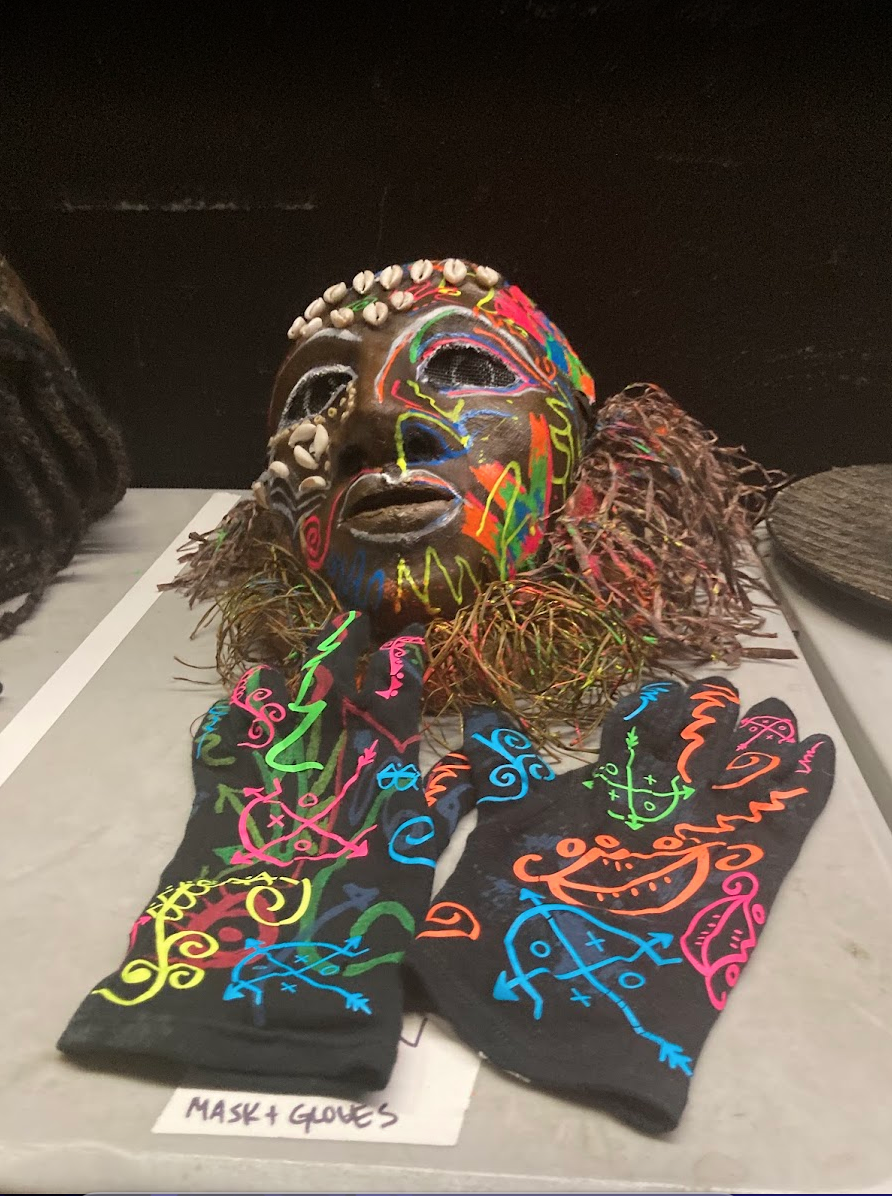
From everything I’ve said so far, it probably sounds like a grim, gritty play — but “The Brothers Size” doesn’t fit in that box. It was also funny, and visual, and musical, and experimental. For example, throughout the show, the characters break the fourth wall to announce stage directions before they perform them, so you hear it verbalized before you see it happen. Dream sequences of Yoruba cosmology featured neon-lit garb surpassing Coachella standards (credit to Dominique Fawn Hill, costume designer), which brought a fantastical edge that managed to fit naturally within the story. The stage was layered with levels of platforms that built dimension and real distance for the characters to scale (credit to Brittany Vasta, scenic designer.)

Featuring Austin Michael Young and Charles Grant. Photos by Jingzi Zhao. Courtesy of Portland Center Stage.

All of this added up to a show more than the sum of its parts. I often find myself writing something along the lines of “in less capable hands, this could have been a huge miss,” when I’m talking about shows doing something risky. That is true for this show on eighteen gazillion levels. There were so many pieces to this, and any one of them, had it been just a little off-kilter, could have ruined the whole thing. Instead, like a sixteen-step recipe in the hands of a Michelin-starred chef, it was a masterpiece.

And that simile isn’t even really a simile, because writer Tarell Alvin McCraney is the screen-and-stagewriting equivalent of a Michelin-starred chef, when you consider he wrote “Moonlight.” That’s right, HE WROTE “MOONLIGHT”!!!!

And just as “Moonlight” was semi-autobiographical, “The Brothers Size” pulls from McCraney’s lived experience: his brother went to jail and, in McCraney’s words, came out “completely changed, and there was no way to help him. I didn’t have the tools, the resources, the access – and still don’t – to make his life better.”

That explains why the heart of this story runs so deep, and why it works so well. It’s fiction, and it’s not. And knowing that Ogun’s anguish, his complete helplessness watching his brother suffer, is based on McCraney’s lived experience makes it that much more powerful.

Having had a stellar rewatching experience at PCS’s “Twelfth Night,” I just bought a ticket to see “The Brothers Size” again. I had to. And this time it’s a perfect bookend: the opening night and the final performance. Only instead of grouping both shows in one post, I’m going to share these reflections now and then come back with my thoughts after seeing it the second time.

I’m curious how it will be different: for me, when I know what to expect; and for the actors, who will have performed it 25 times between now and then. While they’re doing all those matinee and evening performances, I’ll go to the ballet, get a tattoo, visit another state, take my cat in for dental surgery, see Chris Grace as Scarlett Johansson, and host a dinner party. Then we’ll meet back at the stage for one more evening together.

See you in 23 days!

Twelfth Night, 21 Nights Apart

Retrospectives, Reviews

Picture it: Opening night of a Shakespeare production.

You’ve just been told you’re going on as one of the leading roles.

And you don’t know the lines.

That’s what happened at Portland Center Stage’s official opening of “Twelfth Night” on Nov. 29. Right before the curtain rose, the director came out to introduce the production and announce the role of Orsino would be played not by the PCS star performer cast in the role but by the assistant director, who’d received the assignment just a few hours beforehand. She noted he’d carry a script and some of the choreography would be altered, but otherwise the show would go on. She didn’t share the reason for the switch.

I don’t think I was the only audience member squirming in their seat with secondhand anxiety at this real-life mirroring of the classic nightmare scenario: walking onto a stage in front of a packed crowd not knowing the words. In an over-two-hour Shakespeare production, no less. And this was real life. With the central dramatic question shifting to, “Will they pull this off?“, the lights dimmed and the show began.

Tyler Andrew Jones as Sebastian & Lea Zawada as Viola in Twelfth Night, Or What You Will; photo by Andrés López, shared by Portland Center Stage

The impromptu-understudy, Dakotah Brown, did a stellar job. He acted through each scene with a professional grace, glancing down at the script but keeping up with his castmates as he embodied the lovesick duke who conscripts a woman-disguised-as-her-brother to woo a disinterested countess (surrounded by a no-nonsense steward and all-nonsense trio of drinking buddies also warring for her approval.)

The full cast included many familiar faces (“Midsummer Nights Dream” alumni Andrés Alcalá, Nicole Marie Green, Tyler Andrew Jones, Treasure Lunan, and Andy Perkins dazzled and delighted), a few folks new to me but not the PCS stage (Dana Green and Darius Pierce, both bringing heart and depth to their characters) and one PCS debut who slotted into the mix effortlessly and will hopefully be back for future shows (Lea Zawada, a sharp, expressive and hilarious Viola/Cesario). The Bard’s tale was in capable hands, and they deftly wove together the story of adoration, miscommunication, petty revenge and happy endings with collaborative expertise.

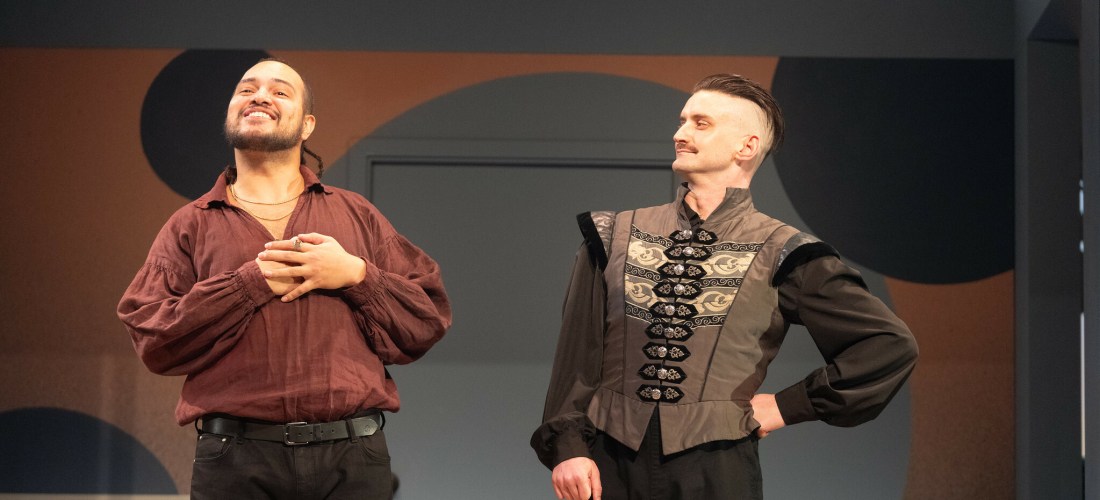
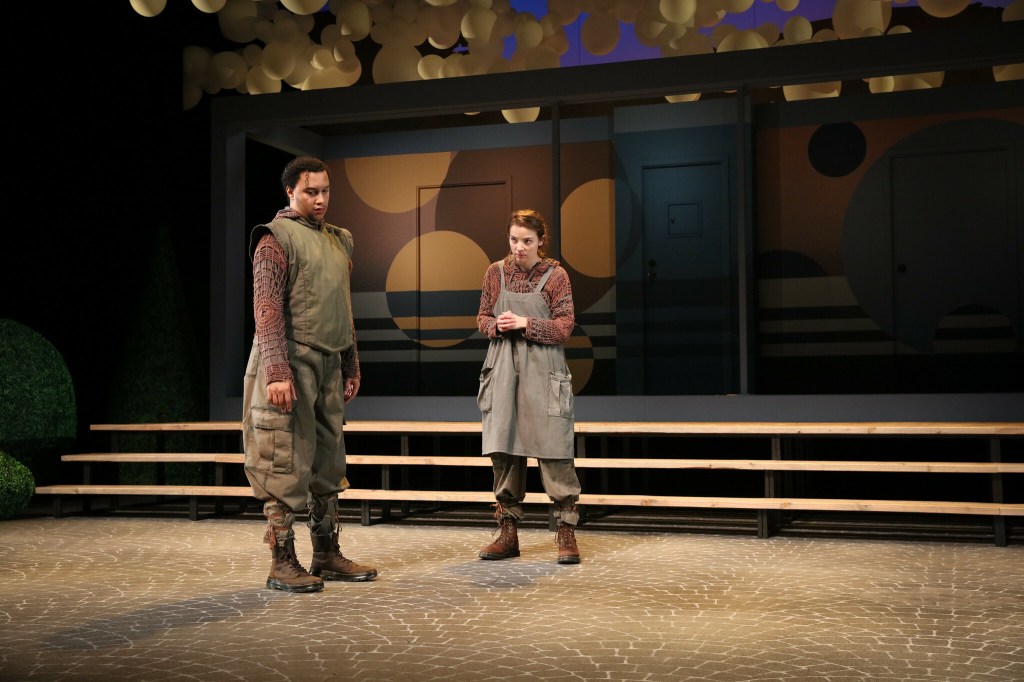
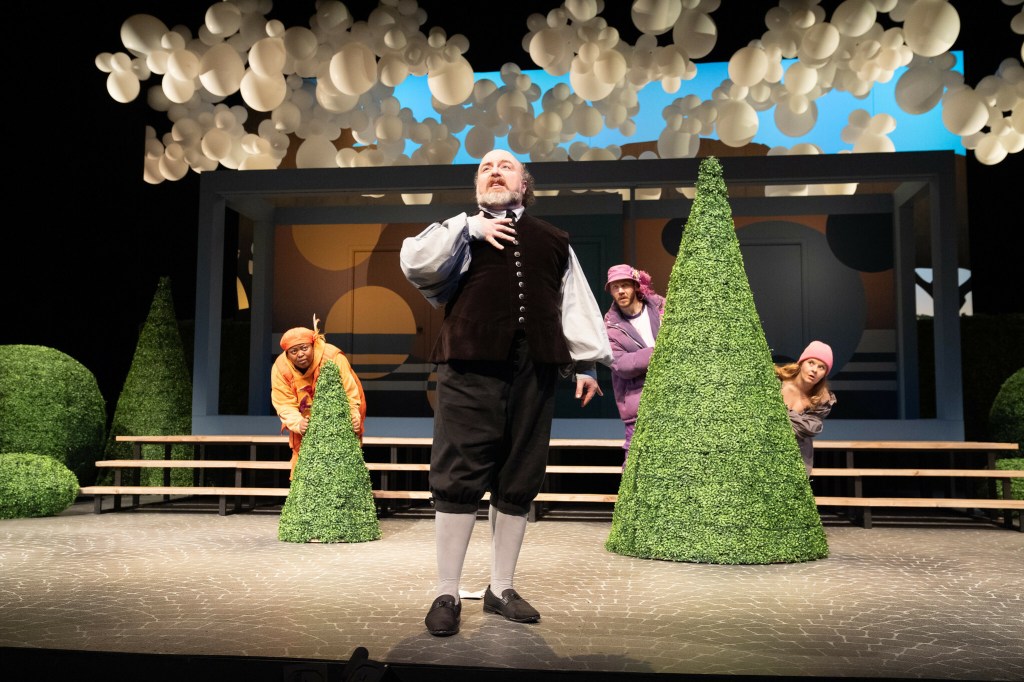
This production wasn’t exactly historical nor modern — it fell somewhere in the middle, accessible to contemporary audiences but not a full “She’s the Man” cell-phone-wielding remake. Sir Toby and Sir Andrew cracked open beers from a cooler, and in lieu of a black veil, Olivia obfuscated herself with sunglasses. The outfits were giving “Shakespeare but make it Portland,” with Viola and her twin in doc martens and Antonio sporting a mohawk. Costume designer Alison Haryer deserves a shout-out for putting the aforementioned beer-chugging sirs in matching neon tracksuits, inviting the audience to take them with all due respect (which is to say, none at all.) Peter Ksander’s sets were sleek and gorgeous, mostly free from props — minus the evergreen trees that enabled the best physical comedy bit in the show as the trio ducked and rolled around to evade detection.

Treasure Lunan as Sir Andrew Aguecheek, Darius Pierce as Malvolio, Andy Perkins as Sir Toby Belch, and Nicole Marie Green as Maria in Twelfth Night, Or What You Will; photo by Jenny Graham, shared by Portland Center Stage

I’d also be remiss not to mention one of the quietest but most impactful pieces of this production, the work of choreographer Muffie Delgado Connelly: short interludes in between scenes where Viola and Antonio, the isolated twins, mirror each other’s subconscious body language, a small wave of the hand or rub of the neck. It’s a welcome breath in between the dialogue-packed group scenes. More importantly, it connects the two storylines through their sibling bond and helps explain how no one can tell them apart.

So, to answer the question from the beginning, did they pull it off? Absolutely. I devoured it, loved it, needed to see it again. As soon as I got home from opening night, I bought another ticket. I could have booked the very last performance, a fitting bookend against the first, but the third-from-last show, the Saturday matinee, was listed as an open-captioned production. As a hard-of-hearing person who uses subtitles for literally everything, I wanted to see how it would change my experience to be able to read Shakespeare’s text in real time.

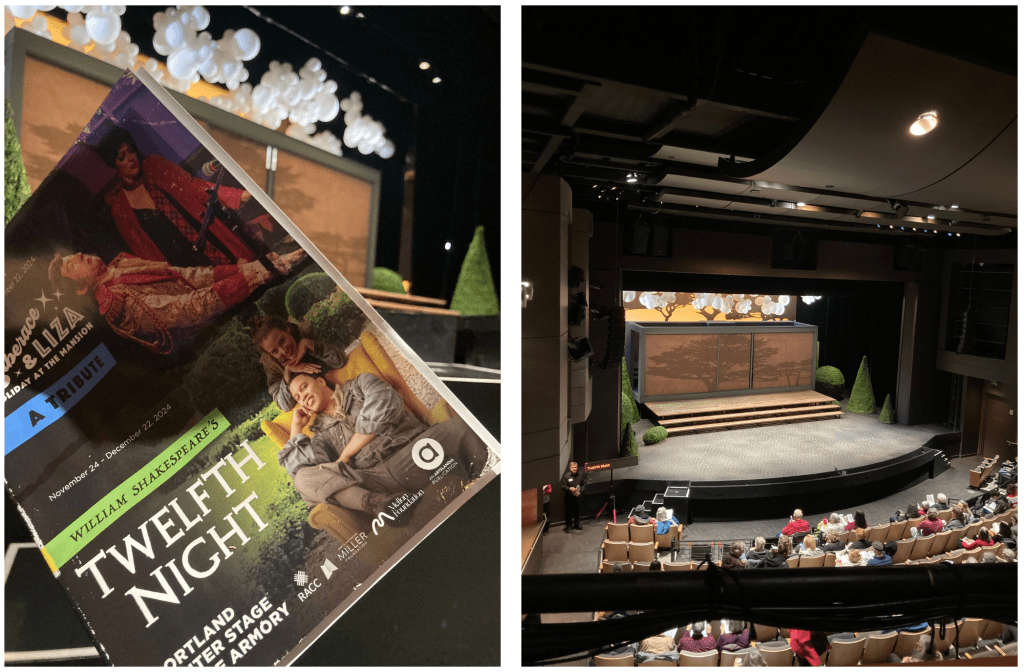
Thus, after a tumultuous three weeks of real-life drama (though no sword fights or realizations the twin I’d assumed was lost at sea had accidentally married the person I was trying to friendzone… so I guess not THAT dramatic), I returned to the theater the afternoon of Dec. 21. I sat in the balcony, which gave me a birds-eye view of the stage but was still close enough to catch all their expressions.

This time, Setareki Wainiqolo (who played an unforgettable PCS Dracula a year ago) stepped into Orsino’s shoes with gusto, announcing “If music be the food of loveplay on!” with such charisma the audience understood why Viola fell hard.

Setareki Wainiqolo as Orsino and Joshua Weinstein as Antonio in Twelfth Night, Or What You Will; photo by Jenny Graham, shared by Portland Center Stage

Without the uncertainty of a script-wielding stand-in, having seen it once before, and with the aid of a captioning display, it was easier for me to immerse myself in the story this time and just enjoy the antics. The only “new” pieces were two dance numbers that now featured Orsino — I now understood what the director, Marissa Wolf, meant when she mentioned alterations, because he’d been missing from those numbers in the first show. One of the enhanced-dances was a trio number with Orsino trying to dance with Olivia who’s trying to dance with Viola/Cesario who’s trying to dance with Orsino, all of them circling each other with barely-concealed desire, which perfectly encapsulated their whole dynamic and was just fun.

That’s what I love about PCS productions. They take nutrient-dense vegetables like Shakespeare and turn them into something you can consume, enjoy and feel satiated afterwards. Like a platter of sweet potato fries paired with a perfect aioli. (Is that a relatable simile, or am I just hungry?) As I return to the Armory time and time again to see familiar faces take the stage, I always know I’m in for a treat.

So after the holidays, I’ll be back to catch the next show at least once. (Probably twice.)

One Last Night With My First Love

Retrospectives

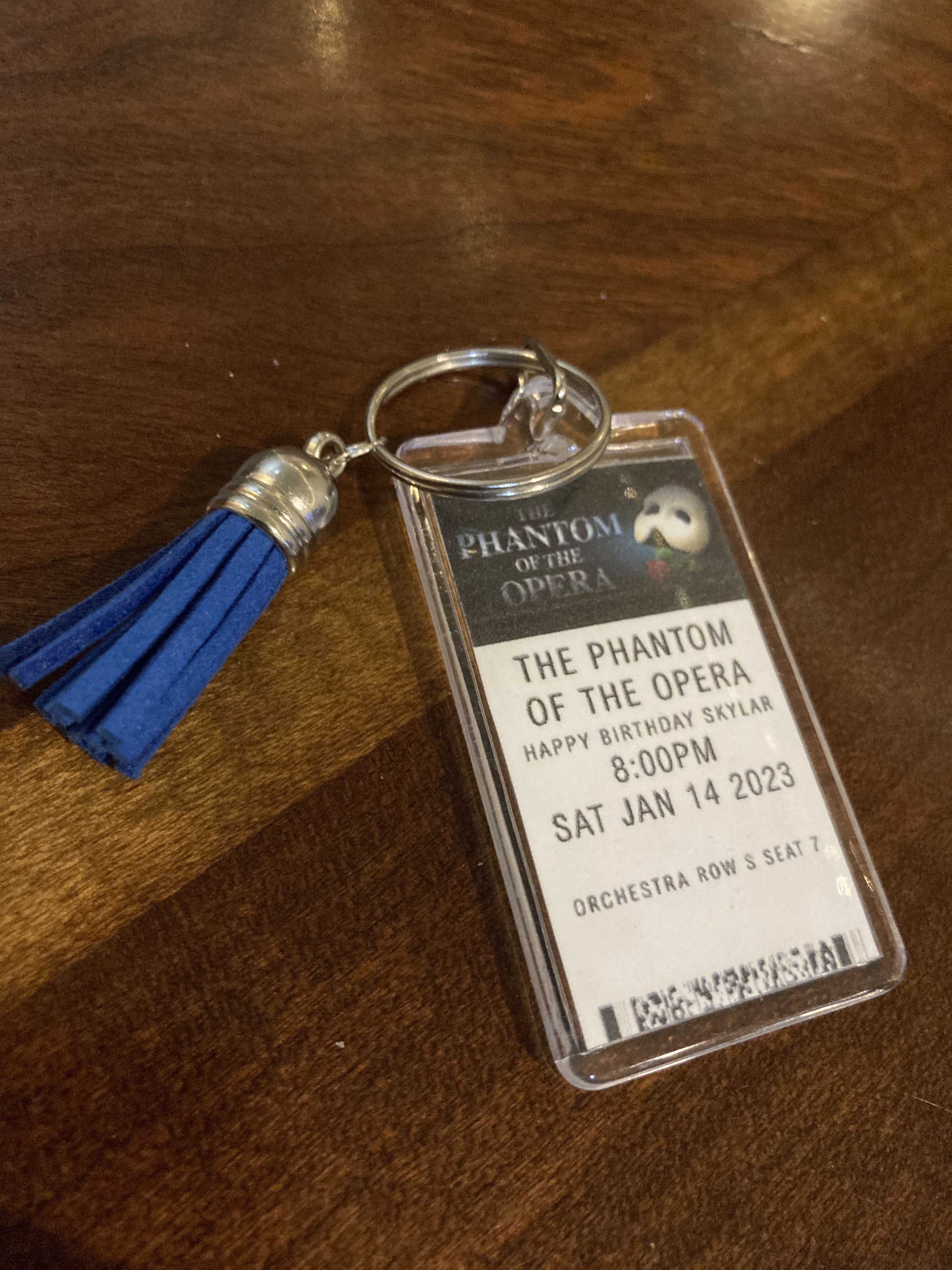
On my birthday back in October, my family collectively gifted me a small white box. I opened it and pulled out a keychain.

“Thank you,” I said sincerely, extricating it from the tissue paper. It was a small bit of plastic shaped like a ticket with the Phantom of the Opera logo on it. I already owned multiple Phantom shirts, posters, mugs, CDs, DVDs, playbills, and signed mask replicas. But I didn’t have a keychain yet — so I was pleased by the gift, albeit puzzled at everyone watching my face.

“Thank you,” I repeated, struggling to affix it to my apartment keys.

“Did you read it?” my sister pressed.

I looked down at it again. The Phantom of the Opera logo. And below it, in small print: 8:00 p.m., January 14, 2023, orchestra row S.

I blinked and shook my head. “No.”

“Yes.”

“No.”

“Yes.”

Then I burst into tears.

See, I have a lengthy relationship with Andrew Lloyd Webber’s 1988 theatrical masterpiece. My late uncle– a New York-based singer — introduced me to the score when I was 8 or 9 on a road trip between Tucson and San Diego in a sun-bleached Toyota Camry. As we drove across the desert, AC trying and failing to keep us cool, he cranked the volume up until the soundtrack blasted through the grainy speakers, bass rocking the car. He’d pause the CD between tracks to explain the characters, plot, and staging. Meanwhile I sat in the backseat, mesmerized with vivid mental images of glittering chandeliers and misty candlelit basements even though I’d never been to the Paris Opera House. Or France. Or an actual theater.

Every musical theater fan has a story of the moment they fell in love with their first musical, the one that opened their eyes to what theater could be and how it could make them feel. This was mine. Later, there would be Les Miz, Wicked, Company, Hamilton, Guys and Dolls, Little Shop of Horrors, Moulin Rouge, Newsies, so on and so forth. But Phantom was the first.

My love grew with every chance I had to see it live: twice on tour in Tucson (birthday presents), once on Broadway (my high school graduation present) and once on West End (after I graduated college.) When the news broke in September that Phantom would be closing on Broadway after 35 years, I was one of the many, many people who were shocked. It had always seemed like a static landmark of New York. Go see the Statue of Liberty, the Met, and Phantom. I was saddened by the news but resigned. Y’know, that’s showbiz.

Until my birthday rolled around and I sat holding not just a keychain, but a promise that, before it closed, I’d get to see my show one last time.

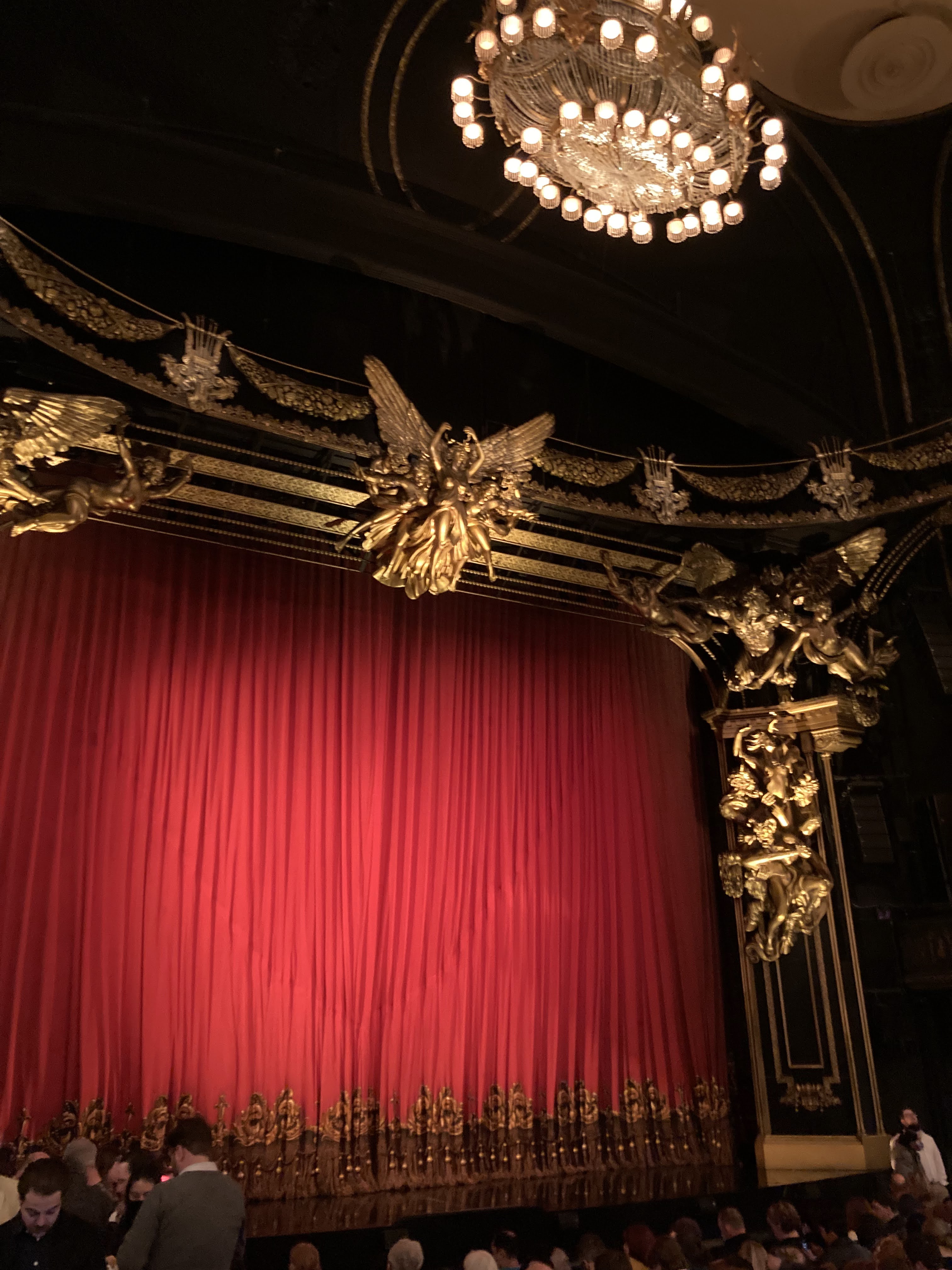
Fast forward three months, a flight, and a subway ride later, I sat in the orchestra of the Majestic as the lights dimmed and the gavel hit the block with a sharp crack. There is no feeling in the world equivalent to the emotional journey of “Perhaps we may frighten away the ghost of so many years ago with a little…. illumination. Gentlemen!” with flashes of light as the chandelier rises and sways above your head. DUH. duh duh duh duh DUHHHHH.

It was the best birthday gift. We returned home a week ago, and I’m still basking in that post-show glow where the memories and music are fresh. That will fade, soon, and the show will close in April.

But at least I’ll still have a sick keychain.