Soccer players must work together to defend their territory, move the ball forward, and predict the opposing team’s moves—all while working against the clock. In order to succeed, they need to communicate.
When all the team members are deaf or hard of hearing, communication takes on a whole new meaning.
Meet Patrick S., a Cochlear™ Baha® 5 recipient and defender on the USA Deaf Men’s National Soccer Team. His passion for the game has helped him find a community of likeminded players who inspire him to learn and grow—both on and off the field.
This article was written for The State Press and published on April 5, 2016.
A young woman, probably in her late twenties or early thirties, takes a few nervous steps toward the audience. Tattoos cover her arms and neck, and “SHERIFF’S INMATE- UNSENTENCED” is printed in bold red letters across her black-and-white striped uniform. She clears her throat, glances around the room and begins to sing.
“I’m not the average girl from the video / And I ain’t tan like a supermodel / But I’ve learned to love myself unconditionally / Because I am a queen,” she sings.
Her voice starts quietly, then builds as the women around her smile in support. When she finishes the song, 12 other inmates join her in a circle and take turns reciting lines in a group poem about self-worth and community.
This isn’t a normal event at Estrella Jail, a Maricopa County facility that houses approximately 1,000 inmates, predominantly female. On Saturday afternoon, the 13 inmates gathered to present their capstone performance as a part of Journey Home, an arts residency program facilitated through ASU Gammage.
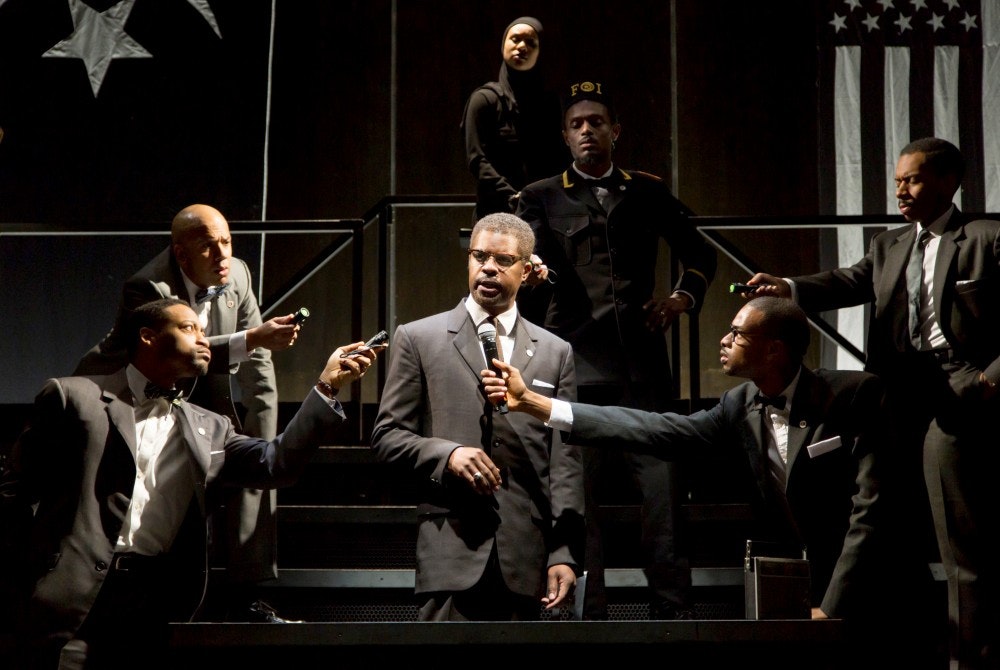
The tour includes performances of Shakespeare’s ‘Julius Caesar’ as well as a new play about the life and assassination of Malcolm X, titled ‘X’
By Skylar Mason
Photo courtesy of T Charles Erickson
This article was written for The State Press and published on Jan. 31, 2017.
In the midst of a tumultuous transition of political power, the arts have a unique ability to put today’s events into the context of history.
That is the belief of The Acting Company, a New York City-based theater company bringing its two latest productions to the Valley this week: Shakespeare’s “Julius Caesar” and Marcus Gardley’s new play about the assassination of Malcolm X, titled “X.”
Lisa Gutting, The Acting Company’s director of education and development, said at their core, the two productions—while set in completely different time periods—have similar themes.
“There are interesting connections on … why a man rising to power is being taken down in an assassination (and) the conspiracy theories that then come forth,” she said. “We hope the audience will make connections to what they’ve seen onstage and want to know more, to do their own historical digging into both Julius Caesar and Malcolm X.”
Associate art professor Angela Ellsworth brings her interest in contemplative walks to campus
Article and photo by Skylar Mason
This article was written for The State Press and published on Nov. 11, 2016.
Every day thousands of students rush from one end of campus to the other — whether on foot, skateboard or bicycle. They bump into and swerve around one another, many plugged in and listening to music or scrolling through Instagram while they move. It’s easy to fall into the motions and spend the lengthy commute preoccupied with a hundred distractions.
What if everyone took a moment to pause, set down their phones and pay attention to the simple act of walking?
“We’re living in a time where everything is so fast,” she said. “We’re pulled in different directions from our phones, computers and all these devices that are constantly pulling and throwing things at us. Our environment is doing that too. So I feel that more than ever, (it’s important) to return and pay attention to our bodies and slow down.”
Ellsworth co-founded the Museum of Walking in the spring of 2014 with intermedia student Steven J. Yazzie as a way of combining their backgrounds in the arts with their interest in movement and contemplative walking. Yazzie graduated from ASU in 2014 and went on to focus on digital video projects, so Ellsworth has since taken over responsibilities as the museum’s director.
This piece was written for my Arts Journalism class. The assignment was to analyze Louis C.K.’s controversial return to comedy in less than 500 words. I submitted the story on Sept. 5, 2018 and received a grade of 100 percent.
Photo courtesy of Kevin Mazur/Getty Images
“I have spent my long and lucky career talking and saying anything I want. I will now step back and take a long time to listen.”
That is how Louis C.K. ended a statement released last November, after he confirmed reports that he had masturbated in front of at least five women in the comedy community. While (as many critics pointed out) he never included the words, “I’m sorry,” the tone was vaguely apologetic.
Less than a year later, he is back onstage. He did a 15-minute set– unannounced– at the Comedy Cellar in New York on Aug. 26. He chose not to comment on recent events, instead focusing his act on “racism, waitresses’ tips, (and) parades,” according to the club owner.
This begs the question: how long is “a long time”? The #MeToo movement is so recent that there’s no standard for how much time perpetrators should take before stepping back into the public eye.
Sure, we could choose an arbitrary length of time. Six months, a year, five years, never…. But every #MeToo situation is different, and there’s no “one size fits all” answer.
Instead, we need to look at the perpetrator’s actions during that time. Have they actually demonstrated repentance and learned why and how their past actions were wrong? Have they used their power in the industry to support the people they have hurt? What steps are they taking to put an end to these misogynistic practices?




 Skylar Mason