As the Oregon Symphony played Beethoven’s Symphony No. 3, I was thinking about Nicole Kidman’s AMC commercial.
“We come to this place for magic. To laugh, to cry, to care. We go somewhere we’ve never been before; not just entertained, but somehow reborn. Together.
Somehow, heartbreak feels good in a place like this.”*
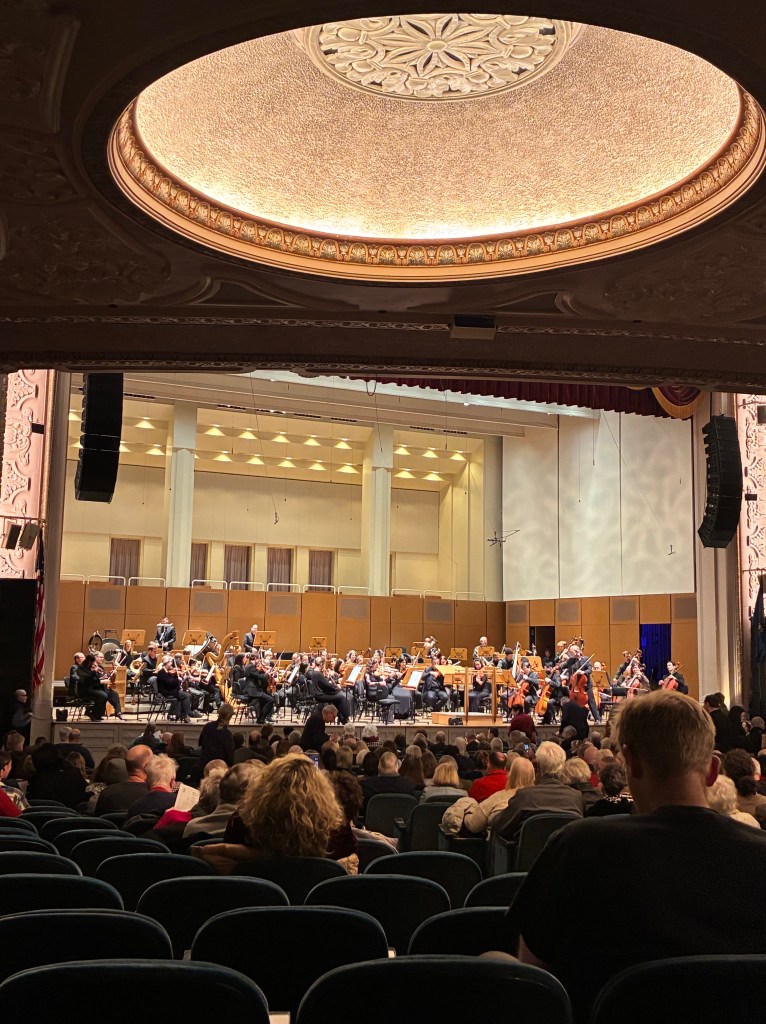
I was 11.4 miles from the closest AMC, seated in the back orchestra of Arlene Schnitzer Concert Hall, smushed between two couples, and my heart was breaking.
Sometimes live music itself can move me to tears, but on Saturday night it was the story behind each piece — and the link between them — that hit me hard and made me think of Kidman’s iconic line. Heartbreak feels good in a place like this.
I was grieving people I didn’t know, missing the people I’ve lost, and simultaneously feeling deep catharsis at how, through art and memory, those people’s legacies carry into the present.
The Oregon Symphony performance combined three works by different composers across different decades. The thread I found running through the evening was our awareness of death, and how it colors our lives and relationships.
We started with Lili Boulanger’s “D’un soir triste (Of a sad evening)” from 1917.
Boulanger was a musical prodigy who died at age 24, and this was one of her last compositions. The program suggested the music to be “a reflection on life’s transience and, perhaps, a lament for what might have been.” You could hear the urgency in the music, the way she was writing to try and outpace the illness that she’d been fighting since she was two years old. Her life was tragically short — but her passion bordering on fervent obsession was her music. I thought about how she’d be gratified that we were listening to her songs over 100 years later on the other side of the world.
Then we moved to Alban Berg’s “Concerto for Violin and Orchestra” from 1935.
The title sounds innocuous enough, and the music is beautiful, lifting the spirits. Until one reads in the program that Berg wrote it as a memorial piece to an 18-year-old girl, an “angel” whose family was grieving her untimely death. Berg died a few months after writing it, and it premiered posthumously. Like Lili, he never got to see his full legacy realized, but it lived on through this performance.
Finally, after stretching our legs, we locked in for Beethoven’s 47-minute Symphony No. 3 in E-Flat Major, Op. 55, “Eroica,” from 1805.
This one isn’t as directly tied to death, but it does include a funeral march, and channels Beethoven’s disillusionment and grief from his lifelong struggles and progressive hearing loss. Before writing it, he secluded himself in the countryside to write his will and testament — seemingly considering his career almost over — but instead discovered a burst of creativity and wrote “Eroica,” launching a new era in music. When it comes to legacy and impact, some could say Beethoven left a bit of a mark.
(/Sarcasm.)
I like to think I have a pretty decent attention span, but in a 47-minute piece of music, the mind is prone to wander. (Today reading about the “Eroica” premiere, I was vindicated to find even audiences in 1805 found it tested their attention spans.) So as the symphony played, I thought about the legacy of these three artists, and how the people I’ve loved and lost live on through their impact, and how the Nicole Kidman quote is quite apt for the symphony, too, and how the same hunger that has fueled artists for hundreds of years — to leave something behind, to touch the lives of people they’ll never know, to preserve what they love — is driving me to write, to contribute to the world’s vast canon in my own small way.
It also crossed my mind that I rarely have an hour and a half to just sit and think about stuff like this, without chasing distractions and checking off to-do’s on half a dozen screens.
An evening at the symphony transports us to a liminal space outside of 2026, an art form exactly as people in 1805 experienced it, a crowd full of strangers “not just entertained, but somehow reborn. Together.”

*Quote condensed for brevity; you can watch the full commercial here.
 Skylar Mason