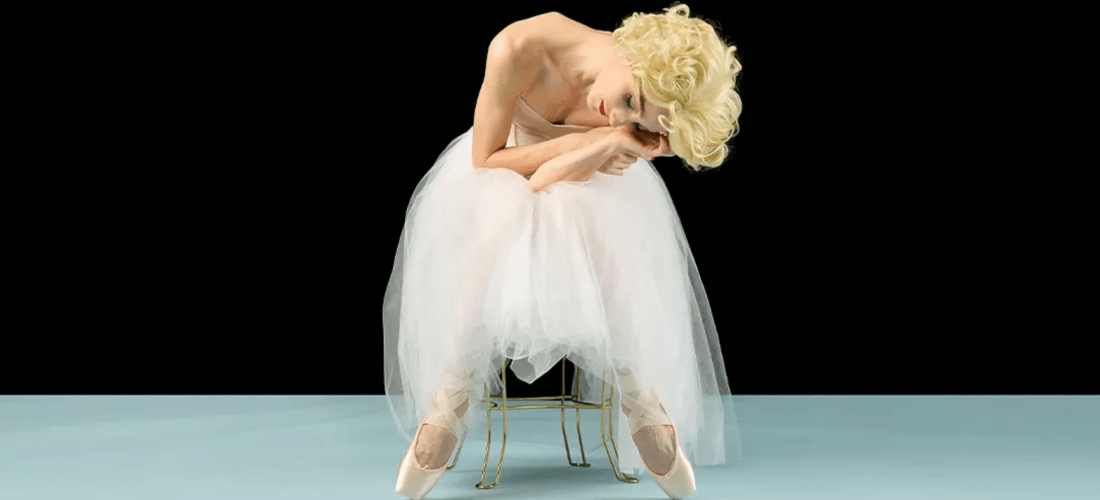
Marilyn Monroe parts a sea of tuxedoed men and saunters down the stairs in a fuchsia gown, hips swaying as she twists wrists bejeweled with glittering diamonds over elbow-length gloves. She smiles at the audience, red lips bright in the spotlight. Then she steps en pointe and dances across the stage to a swelling orchestral arrangement.
Turning the story of Marilyn Monroe’s life into a full-length classical ballet is an idea that never in a million years would have crossed my mind. But luckily it crossed the minds of Oregon Ballet Theatre’s artistic director, Dani Rowe, and costume designer, Emma Kingsbury. According to the program notes, the idea sparked after they watched Kim Kardashian wear Monroe’s dress to the Met Gala and then viewed prints of Andy Warhol’s series depicting Monroe in both color and black and white, perfect and imperfect.
“This contrast spoke to the duality of her persona — the radiant star and the woman struggling with inner demons,” Rowe wrote.
Unlike OBT’s recent productions of “Giselle,” “The Nutcracker,” and “Swan Lake,” (all incredible, by the way) this show was created from scratch by Rowe and the OBT team. I saw it a week into the world premiere production – one of the last performances here in Portland before the show moves on to Oklahoma and Ohio to be performed by their local dancers.
As an original production, there are a million ways the team could have chosen to produce it, merge the story and the form, and make a statement. Many of those approaches could easily have fallen flat. Fortunately, the OBT team pulled it off, creating a brilliant amalgamation of two great things made better through the act of combining them. A chocolate-covered potato chip, if you will.
Narratively, the show tells Monroe’s story through her relationships with the people closest to her: her troubled mother, a series of foster parents, a first love, acting school classmates, second and third loves, a psychoanalyst, and a seemingly neverending stream of costars and production teams. This approach allows the audience to see Monroe not as a static image but as a growing person with as many dimensions as her signature diamonds.
Not exactly a character but a force nonetheless are the paparazzi, portrayed by a series of figures masked and wearing dark uniforms, who lift her up and carry her away and take flash photos and enable and block and comfort and frustrate her in equal measure. Their presence on the stage helps visualize what must have been running through her mind with every step, every word, every smile: people were watching her. Over the course of the show the paparazzi became more aggressive, requiring her to choose whether to fight or let them sweep her off her feet, away from those who know her as a person.
As Rowe said in the quote above, the show focuses on exploring the dichotomy of this dazzling celebrity figure and the real person underneath. On the surface it’s a rags-to-riches story, but digging deeper, we see that the forces that brought her out of poverty and into the spotlight also prevented her from living the life she wanted and connecting with the people she loved. One of the scenes that will stick with me is Marilyn swinging on a (real) rope swing, wistfully watching four women dote on their baby carriages. She wants what they have. They idolize her. Both sides yearn in a “grass is greener” complex. For my part, I sat there watching from the box seat I purchased with my own money, grateful those are no longer the only two life paths afforded to people born female.
I loved, loved, loved seeing the familiar company of OBT dancers in new costumes and environments. They traded the beige and white tunics and corsets of most classical productions for a 1940’s/1950’s wardrobe of neon A-line skirts and business suits — clothing that could make you forget you were watching a ballet until the dancers started dancing. The standout costumes were, as to be expected, Monroe’s: the aforementioned bright pink gown, the white grate-fluttering dress, the President’s Birthday skintight skin-toned number. As much as the show was about de-idolizing Monroe, it was impossible not to get a little swept up in the same allure that captured the world. On the Newmark Theatre stage, she shone.

The cast in this performance was full of my favorite dancers: credit is due to Jessica Lind (Monroe), Charlotte Zogas (child Norma Jeane), Eva Burton (mother), Hannah Davis (young Norma Jeane), Benjamin Simoens (James & psychoanalyst), John-Paul Simoens (Joe & father), Brian Simcoe (Arthur), and Bailey Shaw (Kennedy), as well as the entire ensemble. As with every OBT performance, I was amazed at their technical skill and amazed at how they made me feel the full range of human emotion through wordless movement.
I’ll end with the ending: Monroe, dying a relatively un-dramatized death, a poignant flashback of her youth and dancers from each era of her life, and then giant, sheer tapestries of Warhol’s depictions fluttering down and filling the stage as real recordings of Monroe’s voice played.
After two hours of no voices — just Shannon Rugani’s captivating prerecorded score — Monroe’s voice caught me by surprise and served as a visceral reminder that this was a real life, cut short far too soon. Tears streamed down my cheeks as the curtains fell.
 Skylar Mason
One thought on “You’ve never seen ballet like this”
Comments are closed.