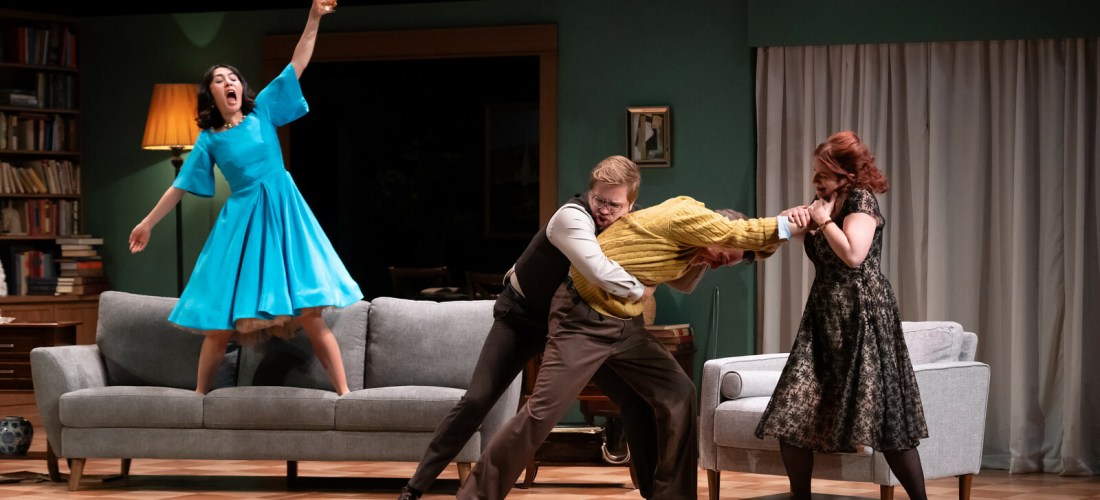
A woman waves around a nearly-empty glass of gin, cozying up to the man on the couch next to her and complaining about all the ways her husband doesn’t measure up. Behind her, the husband in question stalks forward with a gun, aiming it at her head. She turns around and a houseguest screams just as he pulls the trigger — and an umbrella shoots out, spreading harmlessly across the space between them. The party gag elicits nervous laughter and tall pours of hard liquor.
“Who’s Afraid of Virginia Woolf?” spends over three hours frolicking in this sandbox of domestic dark absurdity. The 1962 play by Edward Albee follows two couples on a highwire strung taut over the course of one night as they fight over power, desire, and truth. The gun may have proven harmless, but the couples’ words are locked, loaded, and aimed to kill, demonstrating that those who know us best have the greatest power to hurt us.
Albee’s script calls for a lot of monologuing and sitting. It was also, I repeat, over three hours long. A lesser production could have stumbled at the road blocks, leaving the audience bouncing their legs waiting for it to end. But Portland Center Stage’s expert cast and crew accepted the challenge and delivered an electric performance that made the evening fly by.
Martha (played by Lauren Bloom Hanover) and George (Leif Norby) met each other on the verbal battlefield with equal and opposing force, taking turns playing victim and aggressor as the evening ramped up, teetering and crashing into mutually-assured destruction — the kind of wreck you can’t look away from. To offer a counterbalance and serve as pawns in their games were Nick (Benjamin Tissell) and Honey (Ashley Song), a two-decades-younger couple with the bright-eyed, bushy-tailed optimism the older couple covets and detests. Under the tutelage of alcohol, the four unbutton and unmask themselves to reveal darker needs and fears broiling underneath.
For anyone as unfamiliar with the play (or the 1966 film starring Elizabeth Taylor and Richard Burton) as I was, allow me to explain what confused me: it’s not about Virginia Woolf at all. The title is taken from a recurring bit where Martha and George hum the Disney tune, “Who’s afraid of the big bad wolf,” but sub in Virginia Woolf, whose sometimes cryptic writing was focused on removing layers of pretense. Albee confirmed the “fear” in question is really the fear of living life without false illusions.
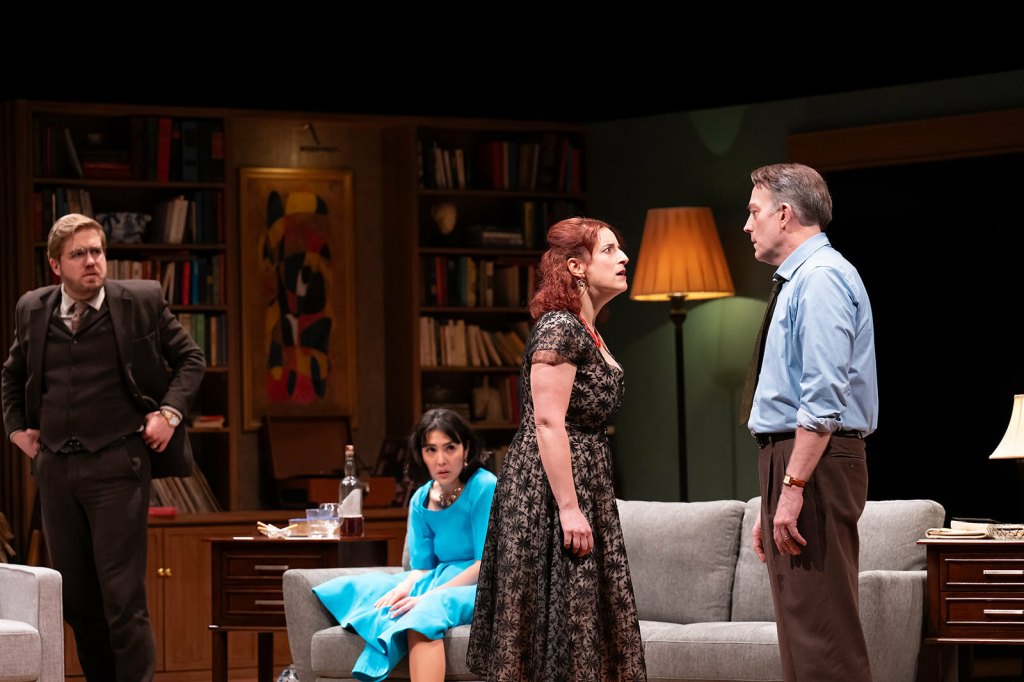
PCS has a flair for modernizing older texts (see their deftly current Shakespeare adaptions I’ve gushed about earlier, where characters tromp in Doc Martens and mohawks), but this production retained its 1960s setting and style. That didn’t keep it from touching on several topics which felt disquietingly applicable to the current moment, such as:
- The tension between history and science/technology, when those who study the transgressions of the past see familiar ideology springing up in the name of “progress” and “perfection.”
- The clash of generations, with the younger scrabbling for a secure foothold and the older watching with a cocktail of jealousy and regret at the years they spent climbing the same hill with nothing to show for it.
- The ways women are presented with a narrower set of choices, a biological and sociological ticking clock, and a reliance on men who may have ulterior motives when they say, “I do.”
- And an increasingly urgent topic: the question of what is truth, what are lies, and how do you tell the difference when you can’t verify it yourself? At the end of the play, some truths come to light. Other questions leave Nick, Honey, and us in the dark. In this time of disinformation and the federal government erasing records of history, it hit close to home.
Speaking of modernization, and Easter egg’d in the title of this post (in true Taylor Swift fashion), we have to talk about “Who’s Afraid of Little Old Me?” Look at how the lyrics parallel the play: “Is it a wonder I broke? Let’s hear one more joke / Then we could all just laugh until I cry,” and an even more direct reference: “So all you kids can sneak into my house with all the cobwebs / I’m always drunk on my own tears, isn’t that what they all said?”
(Martha jokes – is she joking? – that the ice in their drinks comes from her and George collecting the tears from their unhappy marriage in the ice tray.)
It’s funny how theater can galavant our real-world problems, transforming unspoken anxieties into booming soliloquies, and it still somehow feels like catharsis. Sometimes we need to say the quiet parts out loud, or hear them spoken. This production did just that. Like a hangover after 15 glasses of gin or an unkind remark from someone you love, it left its mark.
 Skylar Mason
One thought on “Who’s Afraid of Virginia Woolf? (You Should Be)”
Comments are closed.