This piece was written for my Arts Journalism class. The assignment was to write a 700-800 word analysis of the movie “All the President’s Men” in the context of 2018 politics. I submitted the story on Nov. 5, 2018 and received a grade of 100 percent.
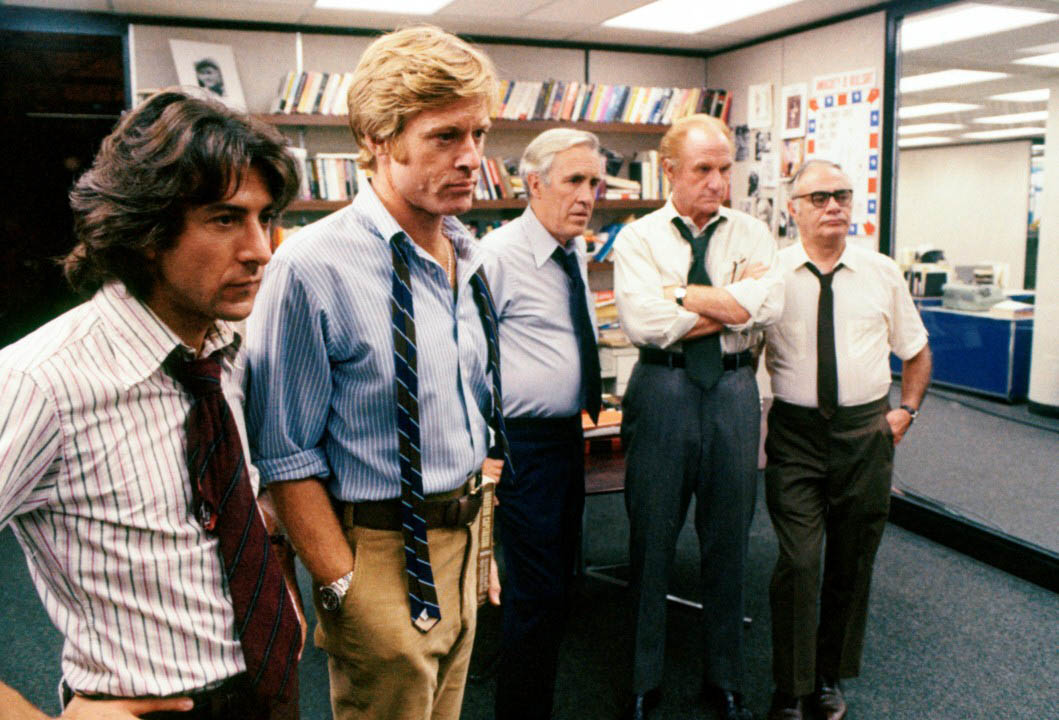
“Nothing’s riding on this except the, uh, First Amendment to the Constitution, freedom of the press and maybe the future of the country.”
Ben Bradlee (played by Jason Robards) offers this quip to reporters Carl Bernstein (Dustin Hoffman) and Bob Woodward (Robert Redford) in the 1976 film about the Watergate investigation, “All the President’s Men.”
He urges the two reporters to check and re-check their facts before publishing their story, because it will rock the government and shake the future of America. (Which it did: the scandal led to 69 indictments, 48 sentencings, and Richard Nixon’s resignation.)
Aside from the very 1970’s hairstyles and rotary phones, the story rings true today. Here are three takeaways from the movie that apply to modern journalism:
- Reporting is a painstaking, unglamorous process
For some reason, many people think reporters just hit speed dial, talk to the president or their insider CIA agent, and write a 12,000-word piece with the facts from one or two sources. That couldn’t be further from the truth.
“All the President’s Men” offers a glimpse of the amount of cold calls, research, problem-solving, independent verification, writing, rewriting, and editing necessary for even a 200-word story. Yet even the movie cuts corners, by necessity: it had to boil thousands of hours of work into a two-hour film.
The audience also gets to “cheat,” in a sense, because they know that something big is going to come of the investigation. The reporters at the time had no guarantees that any of their work would mean anything. Often reporters spend months tracing a lead that doesn’t even merit a story. Yet they press forward, because that’s their job.
A credible news organization will not print false information, nor will they take politicians at their word. The reporting process is designed to uncover and distribute the facts– nothing more, nothing less.
2. Journalists are not the enemy of the people
Last week, President Donald Trump tweeted: “The Fake News Media, the true Enemy of the People, must stop the open & obvious hostility & report the news accurately & fairly.”
Later that day he clarified that he was only referring to “Fake News Media,” not all media, while accusing CNN and “others in the Fake News Business” of purposefully and inaccurately reporting false information.
This type of rant is not new. The sentiment is familiar to anyone who has been listening to Trump, and it can be traced back to his campaign and the beginning of his presidency.
On his first day in office, Trump called journalists “among the most dishonest human beings on earth.”
Later that same week, his then-chief White House strategist, Stephen K. Bannon, told the New York Times that the media was “the opposition party” of the White House.
Anyone who shrugs off the impact of these statements might want to look at the numbers. In June 2018, an Axios/SurveyMonkey poll reported that 92% of Republicans and 53% of Democrats think that news sources “report news they know to be fake, false or purposely misleading.”
“All the President’s Men” is an example of how when government officials are hostile to reporters, it usually means they have something to hide. Convincing the public to distrust the news is a common strategy to avoid being held accountable. It allows the government to operate unchecked, which is a dangerous power.
3. Quality journalism is more important today than ever before
In 2018, we have more information than we could ever hope to process, sitting in the palm of our hand. With so many articles, opinion pieces, and “hot takes” on social media, it’s hard to determine the truth from the lies and exaggeration.
That’s why it’s vital for professional journalists to sift through all the information and determine what’s true, what’s false, and what we need to know as a society.
We cannot do that without news organizations, and they need the support of the public. Instead of bashing “fake news” and then reading whatever clickbait pops up on your Facebook or Twitter feed, subscribe to your local news outlet and a national publication. If you hate the partisanship of several major outlets, find a middle-ground publication– or read from a variety of sources. That is the best way to stay informed with “REAL news” in 2018.
 Skylar Mason